




By: JITENDRA YADAV, Devinder K. Lalotra, Takshak Shankar, Ratender K. Singh, Nidhi Kaeley, Jitendra K. Yadav, Parvathy Sasidharan, Ashima Sharma, Akshaya Balagopal, Devinder Kumar Lalotra Sr., Amrutha Priya CP
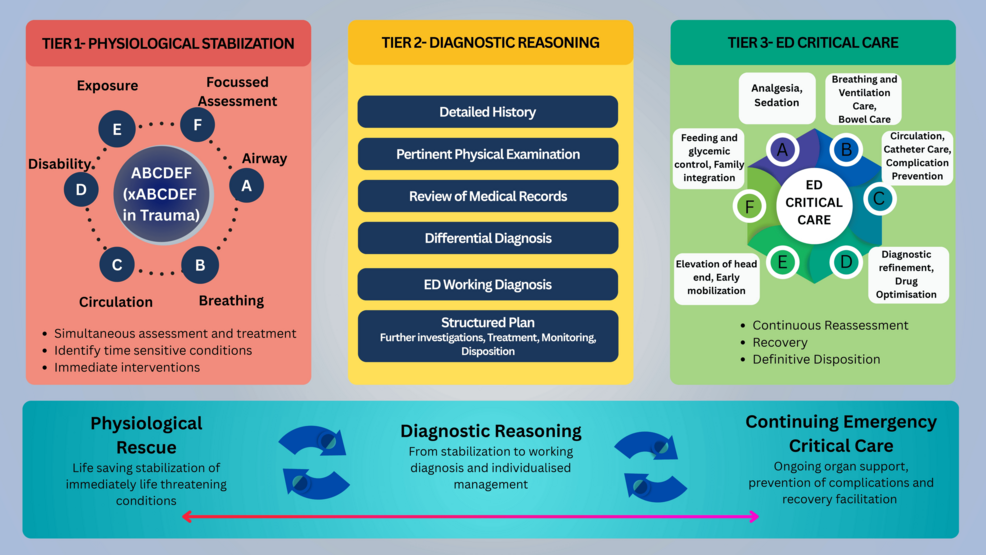
Emergency critical care (ECC) is increasingly recognized as an indispensable component of the critical care continuum, beginning at the point of first medical contact in the emergency department (ED). As critically ill patients spend longer periods in the ED and emergency physicians assume an expanding role in providing ongoing critical care, existing assessment frameworks may not fully address the evolving cognitive demands of ECC. This article describes a conceptual three-tier framework intended to provide a pragmatic strategy for the assessment and management of critically ill patients throughout their ED course. The framework was conceived and implemented at All India Institute of Medical Sciences, Rishikesh. The framework aligns patient assessment and management with three complementary clinical priorities. Tier 1 emphasizes physiological rescue through simultaneous assessment and stabilization using an expanded ABCDEF approach, with a focus on identifying and managing immediately life-threatening and time-sensitive conditions. Following initial stabilization, Tier 2 focuses on diagnostic reasoning, integrating clinical evaluation to establish an ED working diagnosis and guide subsequent management. Tier 3 addresses longitudinal ECC through structured reassessment, optimization of organ support, diagnostic refinement, and prevention of secondary complications while patients remain under ED care. Although presented as three sequential tiers for conceptual clarity, the framework is intended to be dynamic and iterative, allowing movement between tiers according to the patient's evolving clinical status. By integrating principles of emergency medicine and critical care, this conceptual framework provides a cognitive scaffold for clinicians managing critically ill patients in the ED and may support continuity of care, education, and quality improvement. As the framework is currently conceptual, further studies are required to evaluate its feasibility and potential impact on patient outcomes.