
The Founder Thought Leadership Strategy Guide to Accelerate Fundraising Success [Examples + Tips]
Most founders spend months perfecting their pitch deck, but few put the same time and effort into building the kind of reputation that commands investor attention. Investors form impressions long before your first meeting, evaluating your leadership,...
- Home
- Intelligent Insights Blog
- The Founder Thought Leadership Strategy Guide to Accelerate Fundraising Success [Examples + Tips]

Most founders spend months perfecting their pitch deck, but few put the same time and effort into building the kind of reputation that commands investor attention.
Investors form impressions long before your first meeting, evaluating your leadership, market perspective, and industry standing through whatever public footprint exists. By anchoring your presence through consistent earned media, sharp executive commentary, and a clear point of view, you strategically secure trust and credibility long before your title slide appears.
But many founders’ idea of thought leadership ranges from occasionally posting on LinkedIn to becoming a massively followed personal brand.
In reality, founder thought leadership isn’t about becoming a celebrity — it’s about reducing perceived investment risk by building an authentic, authoritative industry presence through strategic earned media.
When done right, it accomplishes three key things:
- It signals market expertise, making you a go-to industry voice.
- It strengthens category leadership, positioning your brand as a market authority.
- It gives investors greater confidence in company leaders, creating the valuation support needed to accelerate fundraising.
In this guide, you’ll learn how a founder-led earned media strategy supports fundraising, reinforces executive visibility, and positions your company for long-term growth.
- Why Founder Visibility Matters in Growth-Stage Companies
- Founder Thought Leadership vs. Personal Branding
- How Investors Evaluate Executive Visibility
- The Founder Thought Leadership Framework
- Integrating Earned Media With Executive Positioning
- How Founder Thought Leadership Supports Fundraising
- Common Founder PR Mistakes
- Building a 12-Month Executive Visibility Plan
Why Founder Visibility Matters in Growth-Stage Companies
Fundraising for growth-stage B2B companies is no longer driven solely by product innovation or financial performance. As Series B–D companies mature, investor due diligence digs deeper into the leadership team, market opportunity, and the ability to deliver on a long-term vision.
A founder’s visibility and reputation has become a more meaningful part of that evaluation. Strategic visibility signals expertise, reinforces market authority, and builds familiarity with those responsible for scaling the business.
Investors Evaluate Leadership, Not Just the Business
At the growth stage, investors aren’t just asking whether a company has built a strong product — they’re assessing its leaders’ ability to:
- Capture Market Share
- Navigate Complexity
- Create Long-term Value
A founder’s public presence influences how investors perceive:
- Market Expertise: Does the founder understand where the industry is heading?
- Strategic Vision: Can they articulate why their company matters?
- Category Leadership: Are they shaping conversations within their market?
- Execution Confidence: Do they demonstrate the experience needed to scale?
So, while founder visibility doesn’t replace business fundamentals — it does strengthen the broader investment narrative by boosting investor confidence in the people running the show.
Earned Media Creates Credibility Signals
Thought leadership carries significantly more weight when validated by third-party sources. What credible industry voices are saying — unpaid and unprompted — confirms founder expertise in a way company-owned messaging can’t touch.
Examples of credibility signals include:
- Executive Interviews
- Expert Commentary
- Contributed Articles and Op-Eds
- Podcast Appearances
- Conference Participation
- Analyst and Media Relationships
These signals help elevate a founder from company spokesperson to recognized industry authority.
Executive Visibility Extends Beyond Fundraising
While fundraising is the immediate goal, having a strong founder visibility strategy adds value throughout the entire growth journey.
A strategically positioned founder presence supports:
- Customer Trust: Enterprise buyers often want confidence in the leadership behind the products or services they adopt.
- Recruiting: Recognized executives attract stronger candidates who align with the company’s mission.
- Partnerships: Industry visibility creates opportunities with strategic partners.
- Analyst Relationships: Consistent expertise strengthens market perception.
- Exit strategy: A recognized leadership team contributes to broader company credibility during M&A discussions.
The goal isn’t simply to be visible — it’s to build a reputation that compounds with the business.
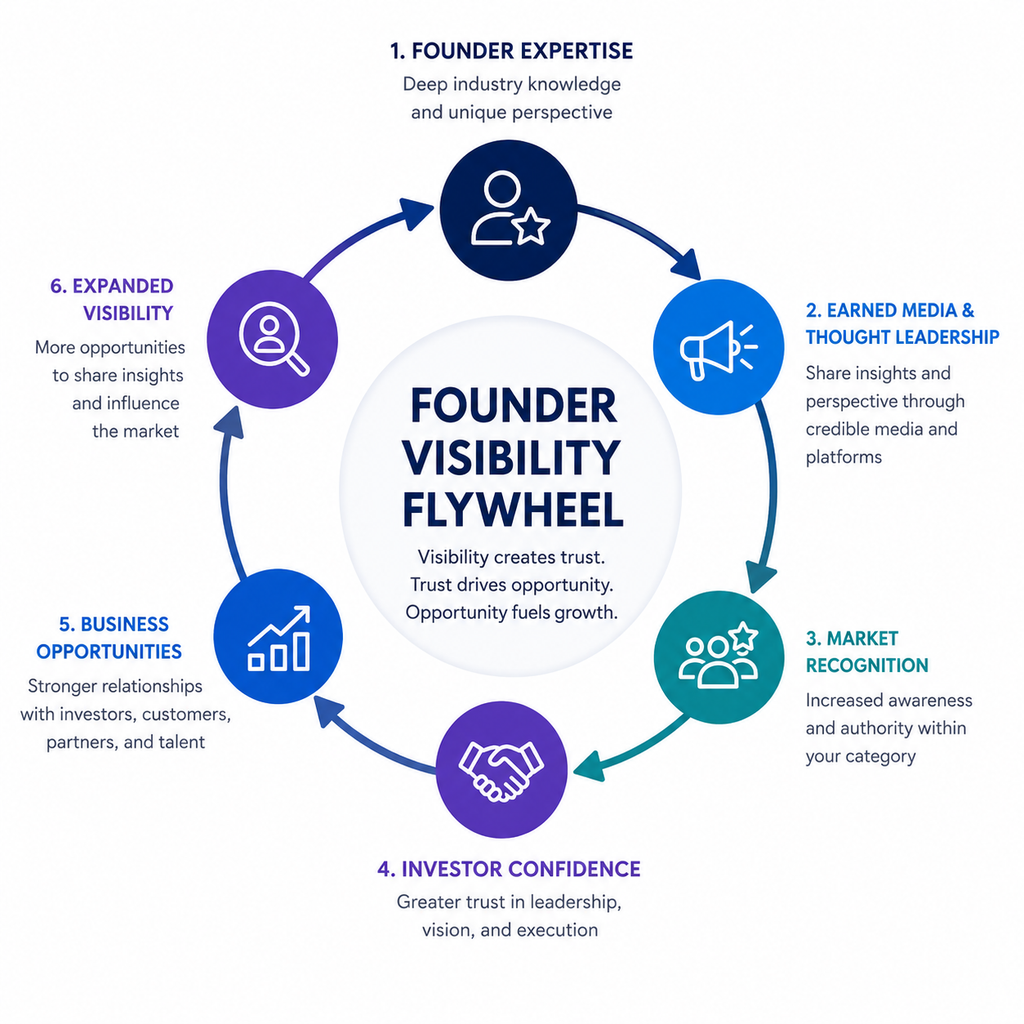
Pro Tip: Build founder visibility before you need it. The strongest executive reputations are developed consistently over time, allowing earned media and thought leadership to influence investor confidence well before a fundraising process begins.
Want to start building that foundation? Read our guide: Executive Thought Leadership: A Comprehensive Guide
Founder Thought Leadership vs. Personal Branding
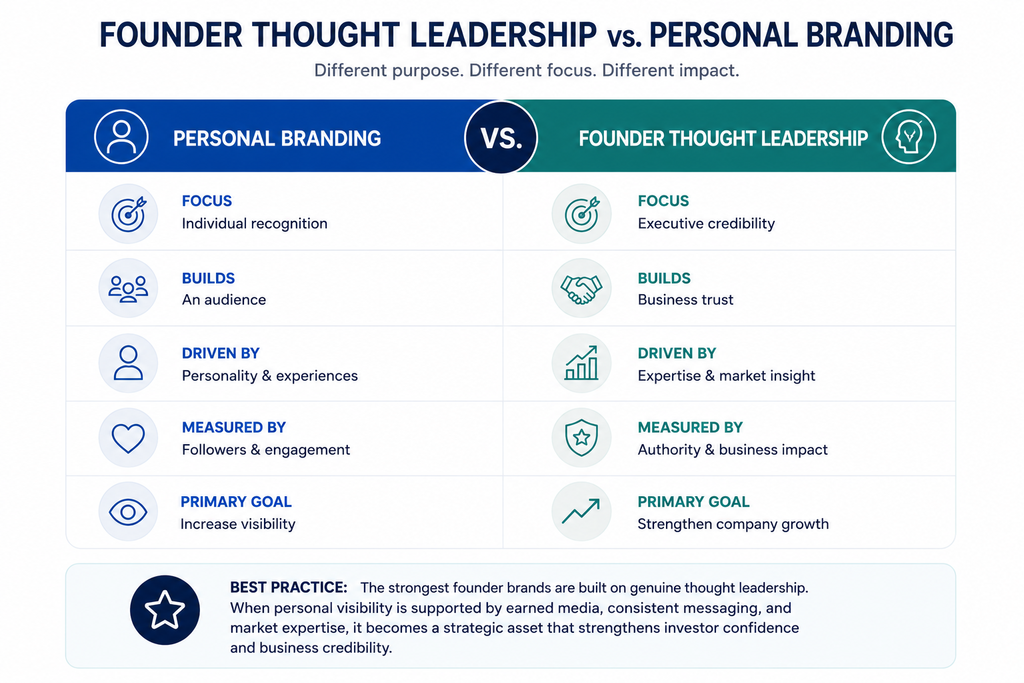
Founder thought leadership and personal branding are often conflated concepts, but they serve very distinct strategic purposes. Both boost visibility, but they’re designed to achieve different outcomes.
Personal branding focuses on building awareness around an individual and maintaining that public image.
Founder thought leadership is about establishing an influential market presence that advances the company’s business objectives. Rather than focusing on followers, founders are positioned as trusted experts who offer insights that:
- Shape industry conversations.
- Strengthen category Leadership.
- Reinforce investor confidence.
For growth-stage B2B companies, the differences are important. A strong social media presence alone isn’t what investors, enterprise buyers, analysts, and strategic partners are looking for.
They expect leadership to:
- Demonstrate Expertise: Create original frameworks and publish deep, data-driven content to prove the value of your knowledge.
- Have a Clear Market Vision: Predict future trends and beat competitors to the starting line with a bold, long-term roadmap.
- Execute: Show how you’re solving industry problems through raw data, transparent reports, and actual results.
Personal Branding Prioritizes Individual Recognition
Personal branding builds awareness around one person and measures success by:
- Audience Growth
- Engagement
- Online Influence
Common activities include:
- Growing a Social Media Following
- Sharing Personal Stories and Career Experiences.
- Publishing Lifestyle or Behind-the-Scenes Content
- Building Recognition as an Individual Creator or Entrepreneur
While these efforts might increase visibility for the individual, they don’t necessarily establish meaningful authority or do anything for the company’s strategic positioning.
Founder Thought Leadership Builds Business Credibility
Founder thought leadership focuses on expertise rather than personality. Every interview, bylined article, conference presentation, or earned media opportunity is aimed at reinforcing market position and demonstrating why its leadership deserves recognition.
You’re not asking, “How do I grow my audience?” You’re answering:
- What market problem do we uniquely understand?
- What category do we want to lead?
- What perspectives can only our leadership team provide?
- How does every media opportunity strengthen our company’s credibility?
Through earned media and executive communications, messaging becomes credibility signals that support the activities investors care about most:
- Fundraising
- Enterprise Sales
- Recruiting
- Long-term Growth
The Most Effective Strategies Combine Both
You don’t have to choose one or the other. Personal branding and founder thought leadership are complementary to one another — especially when they align with a common narrative.
Example: While LinkedIn helps amplify executive insights, those insights carry more weight when they’re backed up by:
- Independent Media Coverage
- Conference Speaking Opportunities
- Expert Commentary in Trusted Industry Publications
Being the loudest voice in the room isn’t the goal — as the saying goes, “empty barrels make the most noise.”
Your aim is to become the most trusted voice in the room.
Pro Tip: Before accepting a speaking opportunity, interview, or creating content, ask if it will strengthen the company’s category authority or simply increase personal visibility? The strongest founder thought leadership initiatives accomplish both — but they always put business credibility first.
For more on how a strategic earned media program helps build visibility that supports long-term growth, read our guide: The Modern Earned Media Strategy Guide for Enterprise B2B Tech Brands [Examples + Tips]
How Investors Evaluate Executive Visibility
Executive visibility rarely ties directly to whether or not a company receives funding. It does, however, influence how investors perceive the leadership team behind the business.
To have a better understanding of leadership before entering the first fundraising meeting, most investors will have already conducted light due diligence.
This includes reviewing:
- Media Coverage
- Executive Interviews
- Conference Appearances
- Other Public-facing Content
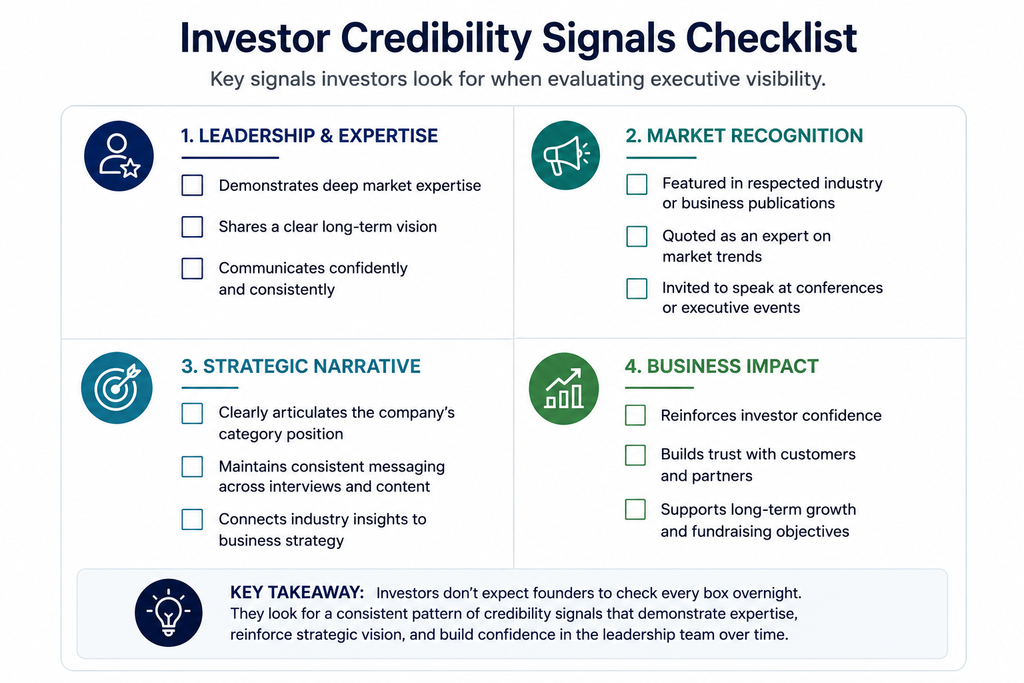
So what are they really looking for in these thought leadership activities? More than recognition, they’re evaluating whether a founder consistently demonstrates the requisite qualities to scale a business in a competitive market.
Leadership Credibility
Investors want confidence in a founder’s ability to execute beyond the current business stage.
Executive visibility and consistent, informed communication on market trends, customer challenges, and long-term strategy builds that confidence.
Founders need to:
- Conduct interviews with respected industry and business publications.
- Offer thoughtful commentary on emerging trends.
- Provide consistent messaging across media appearances.
- Demonstrate an understanding of the competitive landscape.
These thought leadership activities establish a founder as someone who doesn’t just participate in the market — but knows where it’s heading.
Narrative Consistency
Having a compelling vision is one thing. Communicating that vision consistently is another.
Investors often weigh what they hear in a fundraising presentation with what they’ve already seen through:
- Earned Media
- Executive Interviews
- Podcasts
- Speaking Engagements
When those messages support each other, they strengthen confidence in the company’s strategic direction.
Consistent narratives should cover:
- What market problem is being solved?
- Why are we the ones to solve it?
- What’s the founder’s perspective on the industry’s future?
- What’s our long-term business vision and growth strategy?
Fragmented messaging, on the other hand, only creates uncertainty during due diligence.
Third-Party Validation
Third-party validation is one of earned media’s biggest strengths.
Media coverage, conference invitations, and expert commentary carry more weight than company-owned content. Investors won’t base a decision solely on these accomplishments, but they often see external recognition as extra evidence that the founder’s expertise extends beyond the company itself.
To build third-party validation, founders need to:
- Get featured in respected business and trade publications.
- Speak at leading industry conferences.
- Provide journalists with expert commentary.
- Participate in executive panels and roundtable discussions.
Collectively, these activities reinforce the view that a founder is shaping industry conversations within their industry and not just promoting their business.
Visibility Supports the Broader Investment Thesis
The true value of executive visibility is clearest when that visibility compliments strong business fundamentals.
Founder thought leadership doesn’t replace metrics like revenue growth, customer traction, or product innovation, but it does reinforce the broader investment story by making leadership more credible and trusted. It does this by providing the context needed for investors to understand what the company has accomplished and why the leadership team is well-positioned to achieve what’s next.
When you pair executive visibility with consistent execution, it strengthens investor confidence throughout fundraising, growth, and even future exit talks.
Pro Tip: Treat every founder thought leadership activity as part of your investor narrative. Consistent executive visibility creates a body of third-party validation that reinforces the same strategic story you’ll present during fundraising.
Learn which PR metrics, reporting frameworks, and credibility indicators boards and investors actually value here: Beyond Impressions: PR Reporting That Boards and Investors Actually Want to See in 2026 [Example + Tips]
The Founder Thought Leadership Framework
A disconnected collection of podcast appearances, LinkedIn posts, and contributed articles won’t cut it. Founder thought leadership needs to be a system.
Preparing for fundraising at the growth-stage? Your executive visibility should:
- Reinforce a clear market position.
- Strengthen investor confidence.
- Prove the founder understands the industry’s direction.
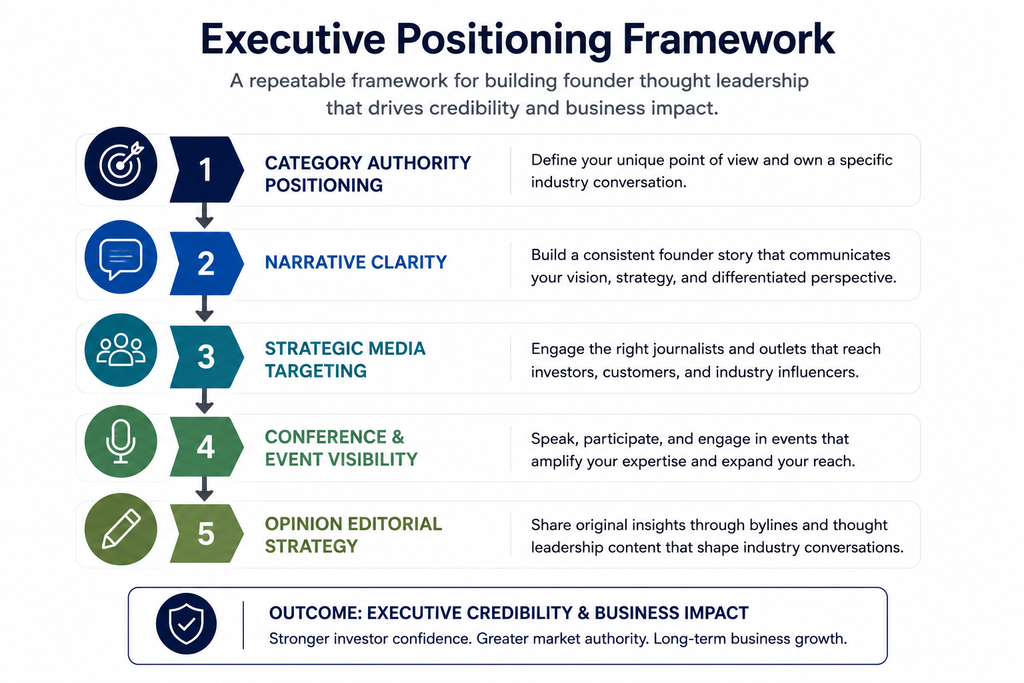
A strong founder media strategy is built around five interconnected pillars, creating an executive positioning engine that transforms visibility into a measurable business asset.
1. Category Authority Positioning
Investors aren’t just evaluating current performance — they’re making sure leadership has the fortitude to build a category-defining business.
This is where you decide specifically what you want to be known for. And the aim isn’t to be known as “the CEO of a software company.” That explains a role, but it doesn’t establish differentiation.
Instead, define the unique market perspective you want to own.
4-Point Positioning with Examples
Strong executive positioning includes:
- Founder Identity: “A cybersecurity founder with experience scaling enterprise security teams.”
- Market Insight: “Traditional security models are struggling to keep pace with AI-driven threats.”
- Category Vision: “The future of cybersecurity requires adaptive, intelligence-driven protection.”
- Business Impact: “Organizations can reduce risk while accelerating digital transformation.”
Clear positioning gives outlets, investors, and stakeholders a reason to pay attention. Being a founder today is no longer about pure company promotion — it’s about offering a valuable, informed perspective on the market’s future.
2. Narrative Clarity
Once you’ve defined category position, every public appearance should reinforce the same strategic narrative. Whether it’s a media interview, presentation, or investor meeting, the core message should remain recognizable.
Consistency builds familiarity, while a fragmented story creates noise and weakens credibility..
It’s far more effective to have a narrative architecture that connects personal expertise, company mission, and broader industry trends.
This simple narrative pyramid helps structure executive messaging:
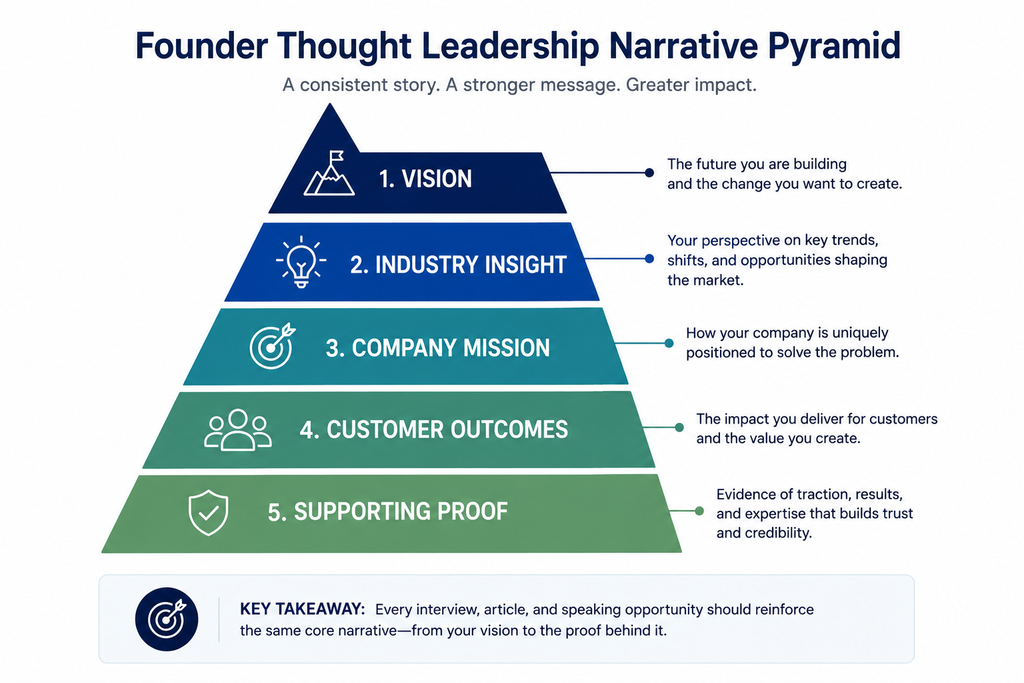
Examples:
- Industry Vision: “AI will fundamentally change how enterprises manage operational complexity.”
- Strategic Perspective: “Companies that successfully adopt AI will prioritize data quality, workflow integration, and measurable business outcomes.”
- Company Expertise: “Our platform helps enterprise teams automate complex workflows using AI-powered intelligence.”
Approaching the narrative this way ensures founder communications are thought leadership-driven rather than promotional.
It also creates a repeatable model for:
- Media Interviews
- Conference Talks
- Investor Conversations
- Contributed Content
3. Strategic Media Targeting
Media opportunities aren’t equal in strategic value.
Instead of pursuing massive audiences, prioritize publications, podcasts, and journalists that reach your target audience.
This also includes:
- Investors
- Enterprise Buyers
- Analysts
- Industry Decision-makers
A balanced media strategy covers:
- Industry Trade Publications
- Business and Tech Media
- Executive Podcasts
- Analyst Commentary
- Vertical Market Publications
The idea isn’t to simply maximize impressions — it’s to build credibility with the people who influence growth. A single interview in a respected industry publication will likely provide more value than dozens of low-relevance mentions because it reinforces expertise with audiences that matter.
4. Conference and Event Visibility
Speaking engagements are still one of the strongest visibility channels for a founder to demonstrate expertise in real time while reinforcing their narrative.
Look for opportunities to participate in:
- Industry Conferences
- Executive Roundtables
- Panel Discussions
- Customer Events
- Analyst Briefings
It’s also important to note that successful conference strategies go beyond securing speaking opportunities.
Approach conferences as part of a larger visibility calendar that includes:
- Pre-event Media Outreach
- Executive Commentary Opportunities
- Panel Participation
- Networking with Investors and Industry Leaders
- Post-event Content Amplification
Example: If you’re preparing for a Series C fundraising round, you might build a quarterly visibility calendar like this:
| Quarter | Visibility Goal | Activities |
| Q1 | Establish category expertise | Contributed articles, industry commentary, podcast interviews |
| Q2 | Expand investor visibility | Conference speaking, executive interviews, analyst engagement |
| Q3 | Strengthen market leadership | Research reports, keynote opportunities, strategic media campaigns |
| Q4 | Support fundraising narrative | Founder profiles, business media outreach, investor-focused storytelling |
A structured quarterly plan creates consistent visibility instead of depending on disconnected moments of attention.
Pro Tip: Don’t treat conferences as one-day events. For maximum value, extend your visibility before, during, and after the event through media interviews, contributed content, social amplification, and ongoing conversations with journalists and industry influencers.
Want to maximize the impact of every speaking opportunity? Learn how a strategic event PR plan keeps coverage, visibility, and momentum going long after the conference ends.
5. Op-Ed Strategy
You can’t be a thought leader without offering original perspectives. Op-eds open the door to:
- Exploring Industry Trends
- Challenging Conventional Thinking
- Shaping Conversations (not simply responding to them)
The best founder op-eds aren’t making company announcements disguised as executive thought leadership — they’re introducing compelling market arguments backed by experience.
Strong editorial angles include:
- A shift happening in the industry that leaders are underestimating.
- A common assumption about the market that is outdated.
- A new framework for solving a major business challenge.
- Lessons learned from building and scaling a company
Example:
- Weak Angle: “Why our AI platform is changing enterprise operations”
- Stronger Thought Leadership Angle: “Why Enterprise AI Adoption Will Fail Without Operational Readiness”
The second approach makes a bold claim and positions the founder as a strategic thinker. It also naturally creates opportunities to connect their expertise to the company’s mission.
Pro Tip: The most effective founder thought leadership programs follow a documented strategy that aligns executive messaging, earned media, speaking opportunities, and thought leadership content around building credibility that compounds over time.
Ready to turn your executive positioning into a repeatable strategy? Learn How to Write an Effective PR Plan [Tips + Examples] that aligns your messaging, media outreach, and long-term business goals.
Integrating Earned Media With Executive Positioning
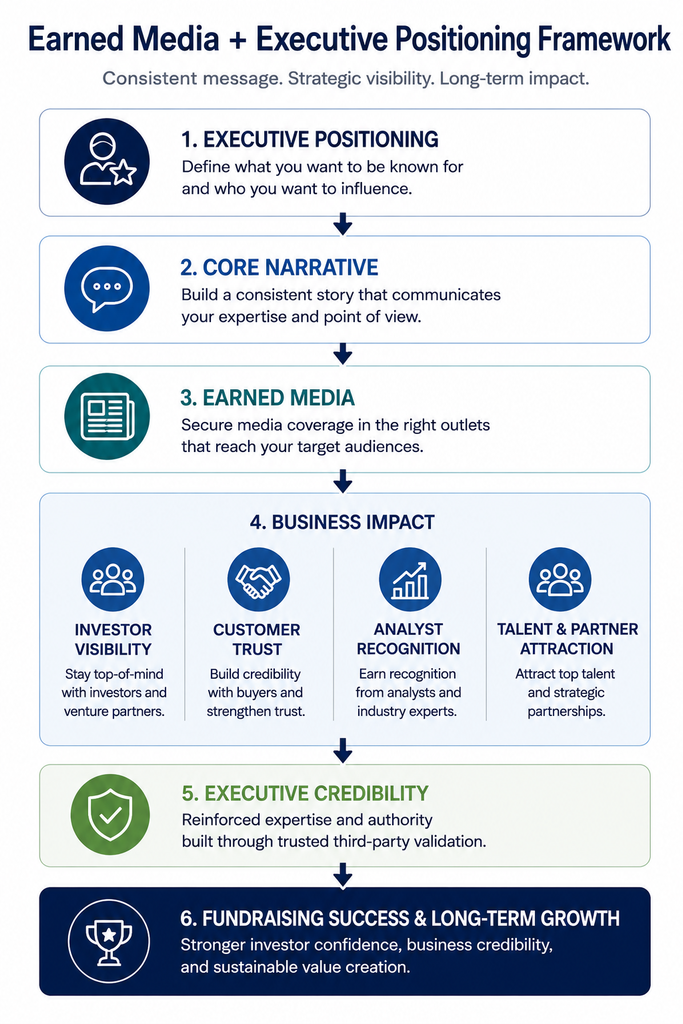
Executive positioning defines your professional reputation, expertise, and unique industry value.
Earned media ensures the right audiences hear your message through trusted, third-party sources. It’s an executive positioning support system that makes you and your narrative credible to those who influence fundraising and business growth.
A podcast appearance here, a contributed article there, or an industry pub feature all have value. But these isolated wins have much more impact when they’re tied to an arterial narrative aligned with business objectives.
When earned media and executive positioning are symbiotic, every media interaction strengthens the same:
- Expertise
- Market Perspective
- Category Leadership
Align Every Media Opportunity to Your Core Narrative
Don’t alter your core message to fit every earned media opportunity. It’s okay to adapt delivery to bylined articles, podcast appearances, conference presentations, etc., but maintain core narrative consistency.
Ask yourself:
- Does this reinforce our category positioning?
- Does it demonstrate executive expertise?
- Does it support the story investors should remember?
- Does it strengthen long-term business credibility?
Cross-channel consistency is key to building recognition and trust over time.
Prioritize Influence Over Reach
In terms of influence, the biggest audience isn’t always the best audience.
For growth-stage B2B companies, executive visibility should only focus on the publications, journalists, podcasts, and events that influence:
- Investors and Venture Partners
- Enterprise Buyers
- Industry Analysts
- Strategic Partners
- Future Employees
An interview on a niche podcast with a modest but highly engaged audience will have more business impact than appearing on a mainstream show with a large, general listenership.
Repurpose Earned Media Across Every Executive Channel
An earned media win shouldn’t die once it’s published.
Extend its life and value by incorporating it into your broader PR strategy:
- Share key insights on LinkedIn.
- Reference media coverage during investor meetings.
- Incorporate quotes into keynote presentations.
- Include notable coverage in sales enablement materials.
- Feature executive interviews on your company website.
This approach creates an ecosystem of consistent visibility where every earned media success leads to future opportunities.
Treat Executive Visibility as a Long-Term Asset
Building a strong executive brand doesn’t stop after a fundraising round ends — it’s a continuous effort.
An always-on earned media plan builds founder familiarity long before they enter investor conversations. This makes executive credibility a long-term asset that grows with the business.
So, you’re no longer asking how to get more press.
Instead, you’re asking how every media opportunity reinforces the executive reputation you’re building over the next 3–5 years.
This shift elevates earned media from a tactical communications activity to a strategic business investment.
Pro Tip: Don’t measure earned media by coverage quantity — measure it by how consistently each placement reinforces positioning, reaches the right stakeholders, and advances your long-term business objectives.
Wondering where earned media fits within your broader communications strategy? Explore how scaling companies balance Paid vs. Earned Media to amplify executive visibility, strengthen credibility, and support long-term business growth.
How Founder Thought Leadership Supports Fundraising
When it comes to fundraising, founders tend to focus on refining their:
- Pitch Deck
- Financial Projections
- Product Roadmap
Those things are essential, but investors are also evaluating the people leading the company.
Founder thought leadership creates a public track record of expertise, strategic thinking, and market leadership to shape that perception before formal fundraising conversations even start.
It also bolsters strong business basics by providing independent credibility signals and mitigating investor uncertainty.
Investors Gain Confidence Through Familiarity
Fundraising rarely begins with the first meeting.
Before due diligence, a lot investors are already aware of a founder through:
- Industry Publications
- Podcast Interviews
- Conference Presentations
- Contributed articles
These touchpoints build on familiarity with context that goes well beyond a pitch deck.
Consistent executive visibility helps investors answer these key questions:
- What does this founder think about the market?
- What’s their long-term vision for the company?
- Are they able to clearly communicate complex ideas?
- What’s their leadership standing within the industry?
When you’re already seen as a credible voice in your category, conversations begin with a higher level of trust.
Third-Party Validation Strengthens Credibility
Investors naturally look for signals outside of the paid or promotional tent that support a company’s potential.
Earned media provides third-party validation because founders are chosen for coverage based on their expertise and industry value.
Examples include:
- Interviews in Trusted Publication
- Executive Bylined Articles
- Podcast Guest Appearances
- Conference Speaking Engagements
- Expert Trend Commentary
These opportunities help prove that the founder’s perspective matters and is recognized beyond their organization.
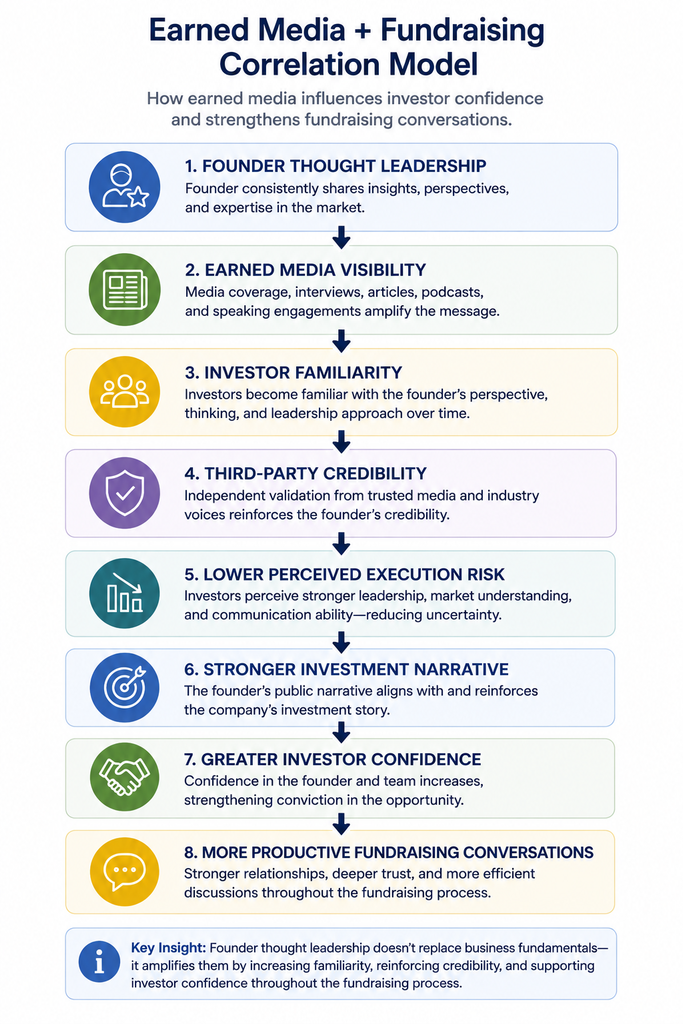
Strong Founder Visibility Reinforces the Investment Story
Truly effective founder thought leadership doesn’t need to introduce a different story — it just has to reinforce the same narrative presented during fundraising.
Example: If your company positions itself as a leader in AI infrastructure, then your media appearances, keynote presentations, and contributed articles should consistently reinforce that expertise.
This creates consistency across every investor touchpoint and makes your company’s market positioning clear and memorable.
Thought Leadership Creates Momentum Beyond the Fundraise
Executive visibility is the gift that keeps on giving.
A well-established founder reputation supports:
- Senior Leadership Recruitment
- Enterprise Customer Confidence
- Analyst Relationships
- Strategic Partnerships
- Future Fundraising Rounds
- Acquisition and Exit Visibility
Think of your founder thought leadership strategy as a continuous value machine.
Pro Tip: Build executive credibility well before you need it. Consistent thought leadership creates familiarity and reinforces your investment narrative over time, helping founders enter fundraising conversations with stronger credibility and greater investor confidence.
Want to understand how PR fits into the fundraising process? Learn how strategic PR helps venture-backed companies build investor confidence, strengthen market credibility, and support fundraising before, during, and after capital raises: Public Relations’ Role in Your Upcoming Investor Road Show
Common Founder PR Mistakes
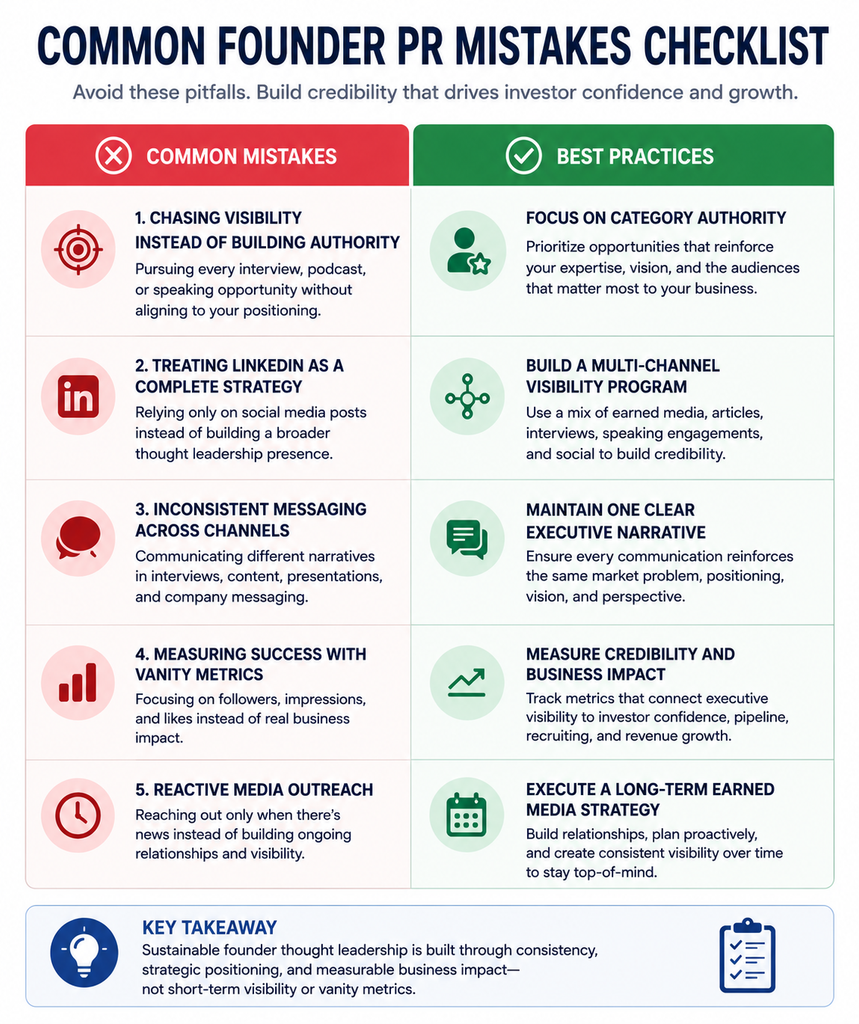
Even the best founders are vulnerable to weakened visibility if their communications lack consistency or strategic direction.
The most common mistakes aren’t about saying the wrong thing — they’re about treating founder thought leadership as a series of separate activities instead of a long-term business strategy.
Avoiding the following top four mistakes helps build executive credibility that:
- Supports Fundraising
- Strengthens Category Authority
- Creates Lasting Business Value
1. Chasing Visibility Instead of Building Authority
Thought leadership doesn’t come from coverage alone
You don’t need to pursue every interview, podcast, or speaking opportunity without first considering how an opportunity aligns with positioning. Increased visibility still boosts awareness, but it might also dilute expertise if the messaging lacks focus.
Prioritize opportunities that reinforce:
- Category Expertise
- Long-term Market Vision
- Strategic Positioning.
- Audiences that Matter Most
Consistency and relevance — not coverage volume — build authority.
2. Treating LinkedIn as a Complete Thought Leadership Strategy
While LinkedIn is a key part of an executive thought leadership strategy, it shouldn’t be the entire strategy.
Too many founders equate thought leadership with making regular social media posts. Posting is good for visibility, but it’s most effective when it reinforces a broader earned media strategy that includes:
- Interviews
- Bylined Articles
- Conference Speaking
- Expert Commentary
Use multiple, trusted channels to create meaningful visibility and build authority over time.
3. Inconsistent Messaging Across Channels
Investors, customers, analysts, and journalists are often familiar with a founder from multiple sources before meeting them officially. If interviews, keynote speeches, company messaging, and social media content have different narratives, it’s more difficult to establish a clear market position.
Every communication should reinforces the same:
- Market Problem
- Category Position
- Long-term Vision.
- Executive Perspective
By maintaining consistent messaging, you become a more trusted, credible, and memorable industry voice.
4. Measuring Success with Vanity Metrics
Followers, impressions, and engagement indicate reach, but they rarely prove real business impact.
For growth-stage companies, executive visibility should ultimately support strategic objectives such as:
- Investor Confidence
- Enterprise Credibility
- Customer Trust
- Recruiting
- Strategic Partnerships
- Long-term Fundraising Readiness
Track metrics that demonstrate how visibility contributed to business outcomes.
Find more resources on PR mistakes to avoid here:
Pro Tip: The best founder PR programs are measured by business outcomes, not media activity. Focus on building a consistent executive reputation that reinforces investor confidence, strengthens category authority, and supports long-term growth.
Want to evaluate whether your executive visibility strategy is delivering meaningful business value? A structured PR audit helps identify messaging gaps, missed opportunities, and areas where your executive positioning can be strengthened before your next fundraising milestone.
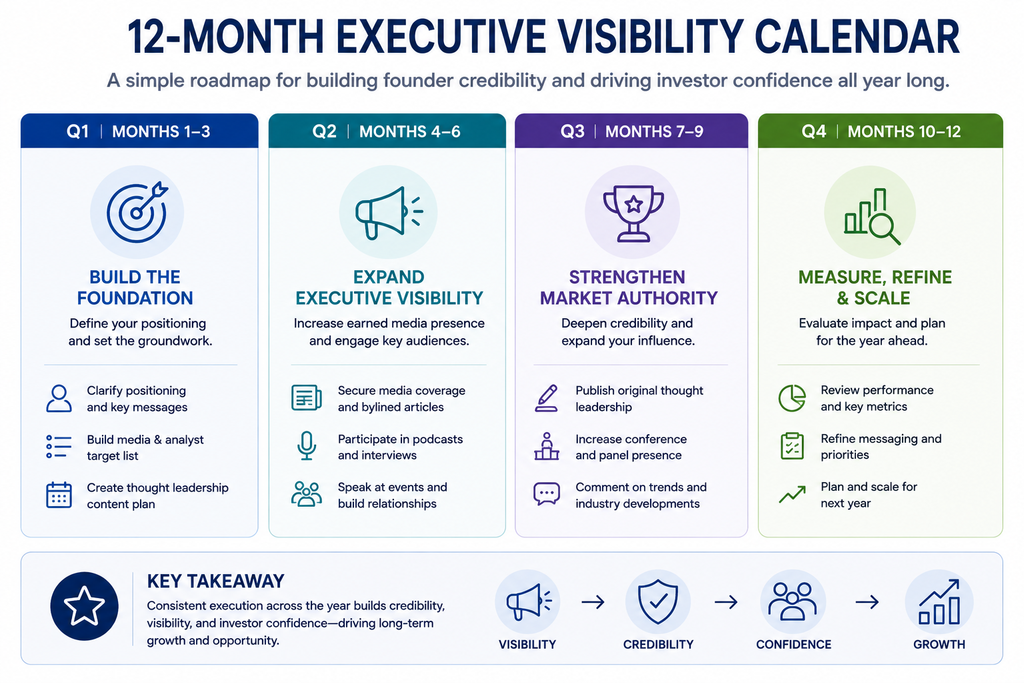
Building a 12-Month Executive Visibility Plan
Effective founder thought leadership is an ongoing business initiative — not a single campaign launched a few weeks before fundraising.
A well-structured executive visibility plan helps:
- Maintain consistent messaging.
- Capitalize on strategic media opportunities.
- Steadily build credibility with investors, customers, analysts, and industry peers.
And by planning visibility over a 12-month period, it’s easier for growth-stage companies to strategically align executive communications with:
- Fundraising Milestones
- Product Launches
- Conference Calendars
- Broader Business Objectives
The following framework provides a practical roadmap for sustaining executive visibility throughout the year.
Q1: Build the Foundation
First, you need to establish a clear executive positioning strategy before pursuing any media opportunities.
Here’s what to do:
- Define your category authority.
- Refine your founder narrative.
- Identify target publications and journalists.
- Build a thought leadership content calendar.
- Align executive messaging with business goals.
Having a solid foundation before you begin outreach means that every future visibility opportunity will reinforce the same strategic story.
Q2: Expand Executive Visibility
Once you’ve established positioning, start increasing executive visibility through earned media and industry engagement.
Prioritize activities such as:
- Media Outreach to Targeted Publications
- Executive Bylined Articles
- Podcast Interviews
- Conference Speaking Submissions
- Industry Commentary Opportunities
Try to create consistent, high-quality touchpoints that not only build familiarity and memorability with your key audiences but also differentiate you from other industry voices.
Q3: Strengthen Market Authority
As executive visibility grows, focus on strengthening your position as a category leader.
Here’s how to do it:
- Publish deep-dive thought leadership content.
- Speak at industry conferences.
- Participate in executive panels.
- Comment on emerging market trends.
- Deepen relationships with journalists and analysts.
This phase of the visibility plan is where consistency helps transform recognition into long-term credibility.
Q4: Measure, Refine, and Scale
Your visibility should evolve with the business.
Regularly review performance by evaluating:
- Quality/Relevance of Earned Coverage
- Category SOV
- Executive Speaking Opportunities
- Narrative Consistency Across Channels
- Alignment with Fundraising and Business Objectives
These insights will help you refine your strategy and plan the next year’s visibility roadmap.
Keep Executive Visibility Aligned with Business Milestones
An effective visibility plan supports the business rather than operating independently of it.
Coordinate executive communications around key milestones:
- Fundraising Rounds
- Product Launches
- Major Customer Announcements
- Industry Conferences
- Annual Reports.
- Strategic Partnerships
If earned media and founder thought leadership efforts are aligned with broader business priorities, every executive visibility opportunity helps strengthen market presence.
Pro Tip: The strongest executive visibility programs are built through consistent execution, not irregular bursts of activity. A 12-month plan ensures every media opportunity and thought leadership initiative backs up your long-term business strategy.
Ready to turn strategy into a repeatable execution plan? Here’s how a structured six-month earned media roadmap helps coordinate executive visibility, media outreach, business milestones, and thought leadership into a scalable communications program.
Executive Visibility Is a Strategic Growth Asset, Not a Marketing Tactic
Founder thought leadership is about building a credible executive presence by consistently demonstrating expertise and value. You’re not chasing viral fame or trying to become a celebrity — you’re building deep trust and recognition, making your company a clear choice for investors.
If you’re a growth-stage B2B company, view executive visibility as a strategic business asset rather than a marketing tactic. Founder narratives, earned media, speaking engagements, and thought leadership must work together to build a powerful foundation of trust that extends beyond fundraising rounds.
Because the same credibility that attracts investors also helps:
- Influence enterprise buyers.
- Recruit top talent.
- Strengthen strategic partnerships.
- Support acquisition or exit opportunities.
The most effective founder thought leadership begins long before fundraising. It’s an early and ongoing reputation-building strategy. You need to invest in executive positioning continuously, so that every media opportunity and public appearance reinforces a clear, consistent story about where your company is headed and why it matters.
Ready to build an executive visibility strategy that supports your next stage of growth? Schedule an Executive Visibility Strategy Session with us to develop a founder thought leadership program that aligns your narrative, earned media, and executive positioning with your long-term business objectives.