
The Modern PR Maturity Model: Building a Predictable Earned Media Engine
Most PR programs fail because they’re purely reactionary. There are compelling stories to be told, but they’re not being told proactively. One quarter, teams are riding a barreling wave of media attention around a product launch while the n...
- Home
- Intelligent Insights Blog
- The Modern PR Maturity Model: Building a Predictable Earned Media Engine

Most PR programs fail because they’re purely reactionary.
There are compelling stories to be told, but they’re not being told proactively. One quarter, teams are riding a barreling wave of media attention around a product launch while the next, they’re waiting for the next set of buzz in a glassy sea of zero coverage.
Then ROI comes into question, journalist response rates drop, and every campaign feels like starting from square one. Sound familiar? If so, it’s important to recognize that the difference between spotty and sustained earned media coverage isn’t about budget size or outreach volume — it’s about PR maturity.
Similar to sales, marketing, and RevOps, PR grows and changes through distinct stages that affect:
- Consistency
- Measurement
- Business Impact
In this guide, we’ll introduce a modern PR maturity model that helps growth-stage and enterprise organizations assess where they are today, identify what’s holding them back, and build a more predictable, repeatable earned media engine that supports long-term business growth.
- What PR Maturity Really Means
- Why Most PR Programs Plateau
- The 5 Stages of the PR Maturity Model
- PR Maturity Self-Assessment
- Moving from One Stage to the Next
- Technology & Workflow at Each Stage
- Common PR Scaling Mistakes
- What Predictable Earned Media Actually Looks Like
- Aligning PR Maturity with Revenue Growth
What PR Maturity Really Means
A PR maturity model is a framework for evaluating how effectively an organization develops its PR capabilities across:
- Strategy
- Media Intelligence
- Execution
- Measurement
- Optimization
Industry PR maturity frameworks use similar capability-based approaches to help organizations assess where their programs stand and identify weak points.
PR maturity doesn’t refer to the size of your team, how much you spend, or the number of placements you generate. It reflects how effectively your organization has developed these capabilities into a repeatable operating system.
The maturity model helps you:
- Identify your current stage.
- Diagnose capability gaps.
- Determine what to build next to make earned media more scalable and predictable.
PR Maturity Is Operational, Not Organizational
Some large enterprises still operate immature PR programs. Likewise, some lean PR teams build sophisticated processes that consistently support business priorities.
The key difference is operational discipline.
As programs mature, they depend less on:
- Individual Campaigns
- Relationships
- Activity Bursts
Instead, teams develop proficiencies that make performance easier to repeat and refine, including:
- Repeatable Processes: Teams follow defined workflows for planning, targeting, outreach, follow-up, and amplification.
- Strategic Alignment: PR priorities connect directly to business objectives rather than operating as an isolated communications function.
- Institutional Knowledge: Journalist relationships, campaign insights, messaging intelligence, and historical performance data remain accessible across the organization.
- Measurement Discipline: Teams consistently track the metrics that reveal what is — and isn’t — working.
- Continuous Optimization: Past performance informs future narratives, targeting, timing, resource allocation, and campaign strategy.
So maturity isn’t just doing more PR — it’s building a stronger operating system around what you’re already doing.
The Five Dimensions of PR Maturity
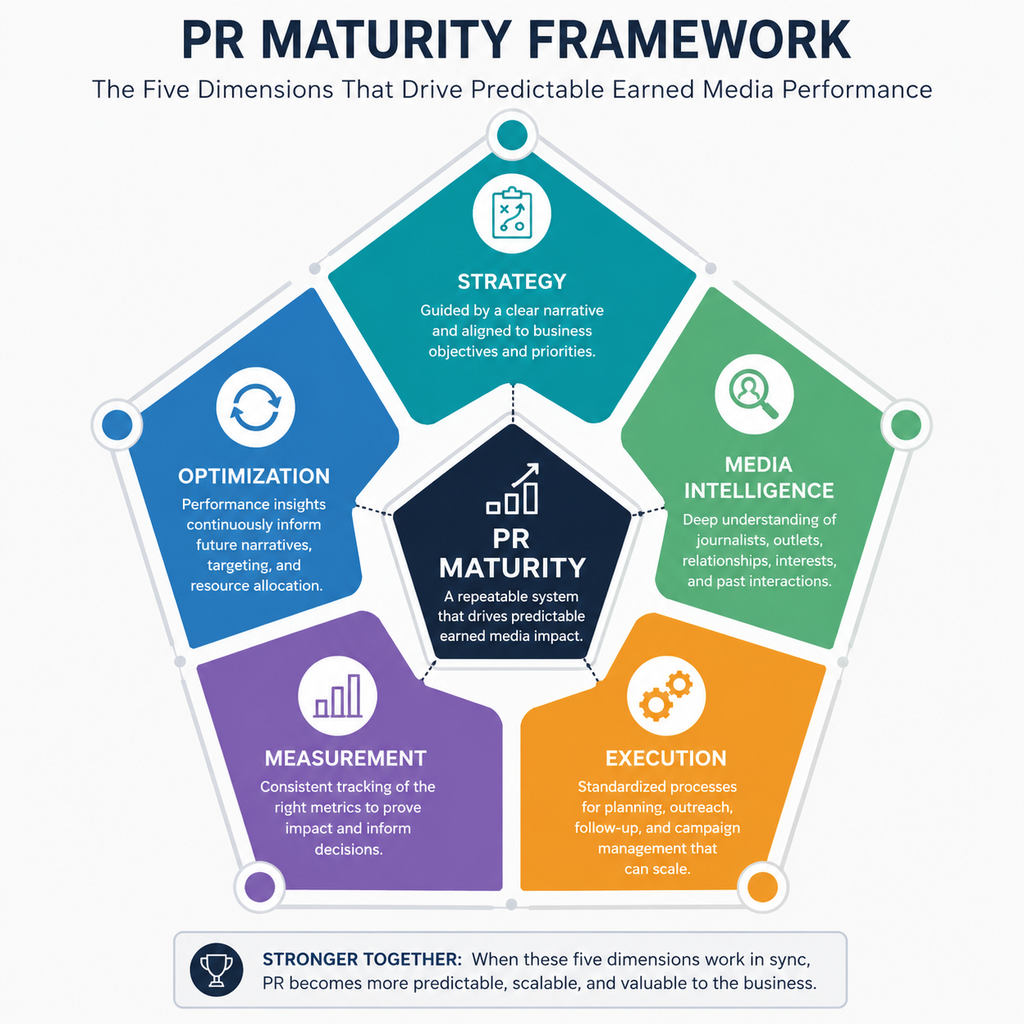
PR maturity develops across many areas, but there are five core capabilities that provide a useful way to evaluate how sophisticated a program has become:
- Strategy: Is PR guided by a long-term narrative and business objectives, or primarily by individual announcements and opportunities?
- Media Intelligence: Does the team maintain actionable knowledge about journalists, outlets, relationships, interests, and previous interactions?
- Execution: Are planning, pitching, follow-up, and campaign management standardized enough to repeat and scale?
- Measurement: Can the organization evaluate performance beyond placements, impressions, and activity metrics?
- Optimization: Does performance data actively change what the team does next?
Some dimensions mature faster than others.
Example: Your company might have sophisticated reporting but inconsistent outreach workflows. By identifying those gaps, you determine where additional capabilities — not just more activity — are needed.
Why Mature Programs Become More Predictable
Earned media predictability doesn’t mean guaranteed coverage. Ultimately, it’s journalists who decide what they cover, and external factors — from news cycles to competitive announcements — will always influence those decisions.
A mature PR program makes the process behind performance more predictable.
Every campaign generates intelligence that informs the next one. To refine your processes post-campaign, you need to answer:
- Which narratives resonate?
- Which journalists engage?
- Which outreach windows perform best?
- Which types of coverage contribute most meaningfully to business objectives?
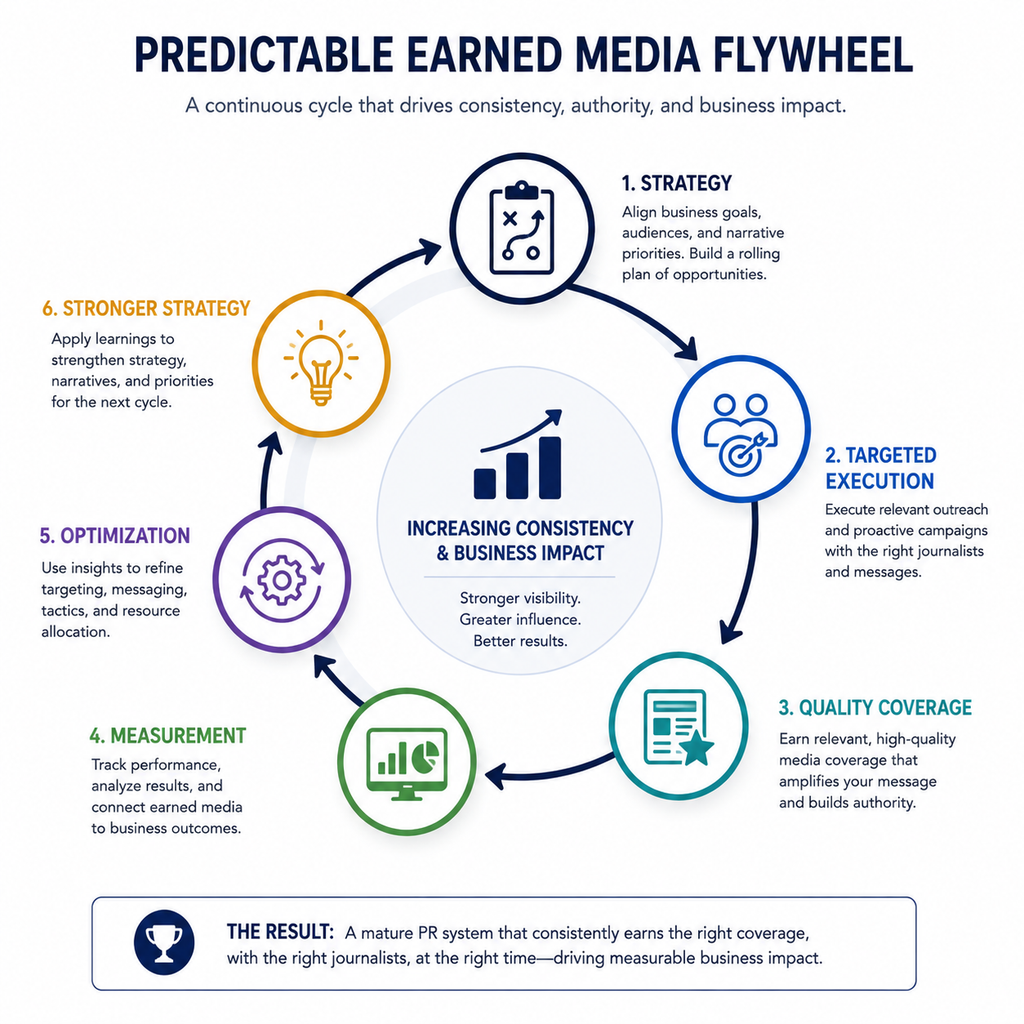
Over time, this creates a feedback loop:
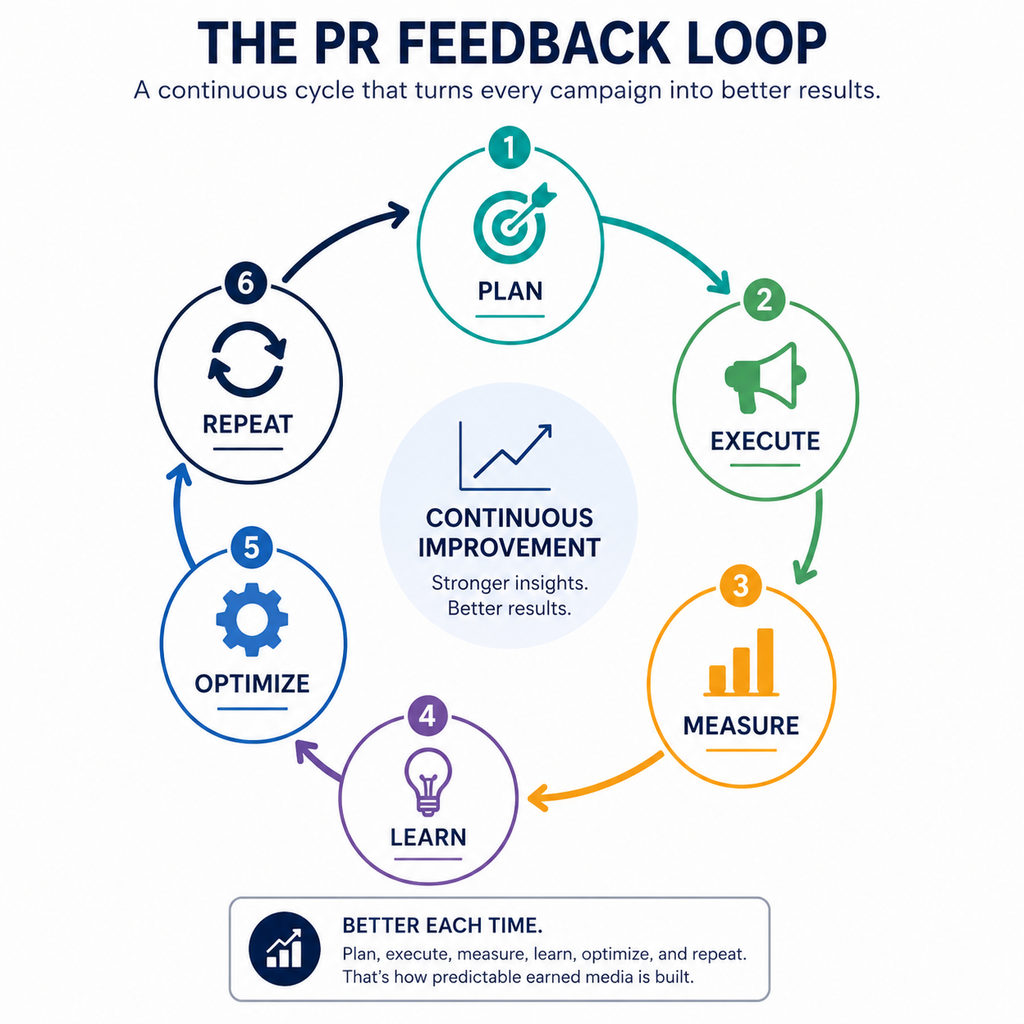
Instead of resetting after every campaign, compound what you’ve learned. Over time, you’ll notice that:
- Resource allocation is smarter.
- Outreach is more targeted.
- Performance expectations are more realistic.
- Earned media results are increasingly consistent.
Pro Tip: Don’t evaluate PR maturity by asking, “How much coverage are we getting?” Ask, “How much of what we’re learning from that coverage is improving what we do next?” Mature programs turn every campaign into intelligence for the next one.
Ready to put these principles into practice? Explore our Modern Earned Media Strategy Guide to learn how enterprise B2B organizations build a more structured, scalable approach to earned media.
Why Most PR Programs Plateau
Many PR programs flatten out because they’re built for reactive execution instead of repeatable performance.
As your organization grows, ad hoc outreach becomes harder to scale. This makes consistent media coverage, meaningful measurement, and long-term business impact increasingly difficult.
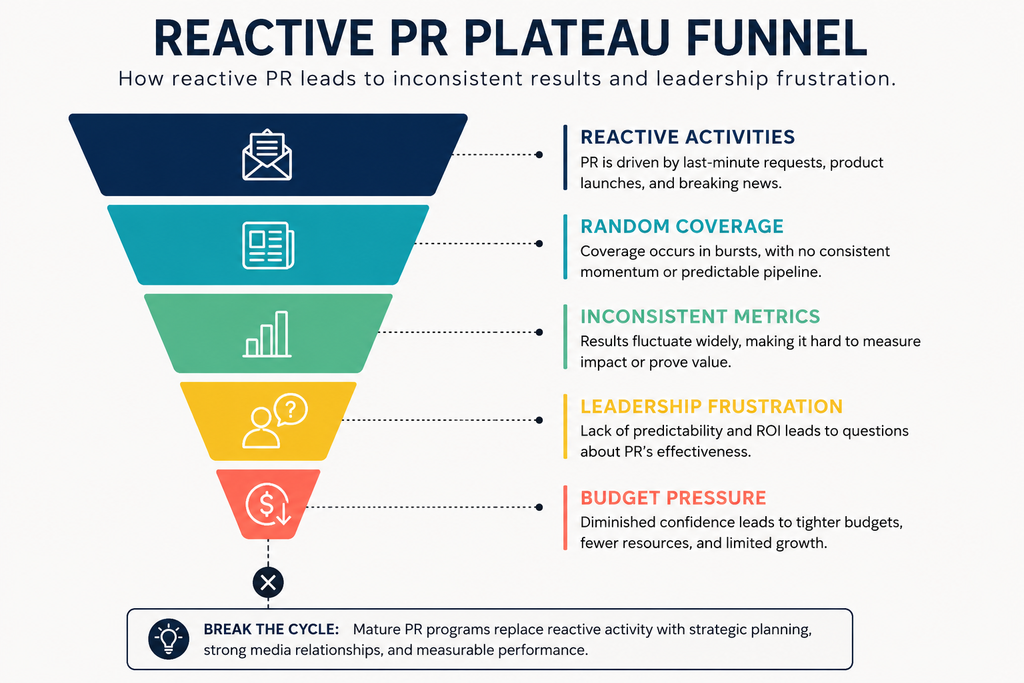
Reactive PR Creates Random Results
Reactive PR is “what’s happening today” vs. “what’s planned for tomorrow.” Instead of following a structured roadmap, teams bounce from one coverage opportunity to the next.
This makes it more difficult to gain momentum or build meaningful relationships with journalists.
Reactive PR is when teams:
- Pitch only when major company news occurs.
- Create media lists from scratch for every campaign.
- Chase trending topics without a long-term narrative.
- Respond to executive requests instead of following strategic priorities.
- Measure success campaign by campaign instead of over time.
While this approach sometimes produces impressive coverage during major announcements, the results are unpredictable because they’re not backed by a repeatable system behind them.

Why More Outreach Doesn’t Solve the Problem
When there’s a lull in coverage, the natural instinct is to:
- Send more pitches.
- Publish more press releases.
- Increase outreach volume.
While activity ramps up, results often do not. Because the bottleneck usually has nothing to do with effort and everything to do with operational maturity.
An increase in outreach only scales inefficiency if it lacks:
- Clear Messaging
- Targeted Journalist Segmentation
- Defined Workflows
- Performance Measurement
Journalists receive more irrelevant emails, internal teams waste time reacting instead of planning, and leadership sees little to no improvement despite greater investment.
The best programs aren’t successful because they send more pitches — they’re successful because every campaign builds on:
- Accumulated Knowledge
- Stronger Media Relationships
- Continuously Refined Processes
Signs Your Organization Has Reached a Plateau
PR plateaus are gradual at first, so they’re easy to overlook until the upward trajectory begins to level off.
If several of the following challenges are familiar, your program may be fast approaching the limits of its current operating model:
- Media coverage fluctuates dramatically from quarter to quarter.
- Journalist response rates continue to decline.
- Campaign planning starts from scratch each time.
- Success depends on a handful of major announcements.
- Reporting focuses on outputs rather than business outcomes.
- Leadership questions PR’s long-term value or return on investment.
- Teams struggle to connect communications efforts with broader business goals.
Spotting these warning signs is the first step toward building a more scalable and predictable PR program. Instead of putting more time and effort into the same reactive framework, improve the systems, processes, and measurement practices that drive consistent earned media performance.
Pro Tip: Before investing in more campaigns, evaluate whether your current PR processes are built to scale. Improving operational efficiency often delivers greater long-term gains than simply increasing outreach volume.
For more on evaluating PR efficiency, read our guide: The PR Audit Guide: A Step-by-Step Framework for High-Performance Teams
The 5 Stages of the PR Maturity Model
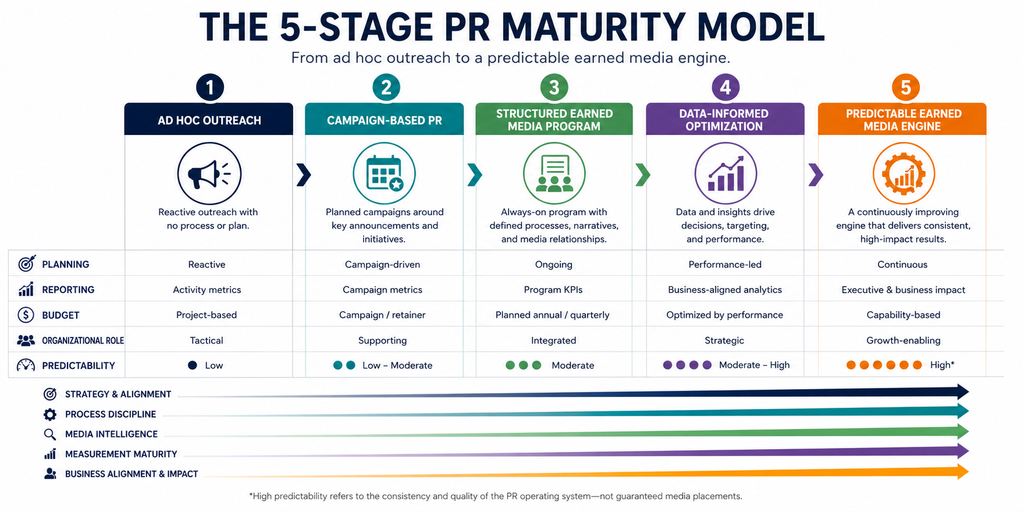
PR maturity doesn’t happen overnight. It’s a five-stage progression.
Strategy, processes, measurement, and institutional knowledge become more sophisticated as you move from reactive outreach toward a more structured earned media machine that delivers increasingly consistent performance:
| Stage | PR Maturity Level | Primary Focus |
| 1 | Ad Hoc Outreach | Reactive execution |
| 2 | Campaign-based PR | Structured campaigns |
| 3 | Structured Earned Media | Repeatable operations |
| 4 | Data-informed Optimization | Measurement and intelligence |
| 5 | Predictable Earned Media Engine | Continuous optimization |
Your organization doesn’t have to mature evenly across every capability. You might have Stage 4 measurement but Stage 2 media intelligence, which is why the model should be used to identify bottlenecks rather than simply assign an overall score.
Stage 1: Ad Hoc Outreach
At Stage 1, PR happens when something needs attention — product launch, funding announcement, executive request, or breaking industry story.
These things trigger outreach, but there’s very little infrastructure linking one opportunity to the next.
- Characteristics: Reactive pitching, inconsistent media lists, limited planning, and heavy reliance on individual relationships.
- Common Mistakes: Prioritizing outreach volume, pitching without a clear narrative, and treating every campaign as a fresh start.
- Reporting Style: Placements, impressions, press mentions, and other basic activity metrics.
- Budget Structure: Irregular or project-based spending tied to immediate needs.
- Performance Expectations: Occasional coverage wins with significant month-to-month variability.
- Organizational Maturity: PR is primarily viewed as a tactical communications function rather than a strategic business capability.
The maturity signal is leadership recognizing that individual wins in isolation aren’t creating sustained momentum.
Stage 2: Campaign-Based PR
The second stage is where your organization becomes more proactive, but PR still revolves primarily around individual campaigns.
Teams still plan around:
- Launches
- Events
- Research
- Funding Milestones
- Executive Announcements
Think of this stage as the precursor to an always-on strategy.
- Characteristics: Defined campaigns, basic editorial calendars, reusable media lists, and clearer messaging.
- Common Mistakes: Evaluating campaigns in isolation, allowing quiet periods between initiatives, and focusing heavily on announcement-driven coverage.
- Reporting Style: Campaign-level metrics, outlet quality, message pull-through, and basic engagement indicators.
- Budget Structure: Quarterly, campaign, or retainer-based budgets with resources concentrated around major initiatives.
- Performance Expectations: More consistent campaign performance, but overall media momentum still fluctuates.
- Organizational Maturity: PR gains greater internal visibility but remains closely tied to launches and marketing calendars.
The maturity signal here is when you begin asking how individual campaigns contribute to a broader and continuous media strategy.
Stage 3: Structured Earned Media Program
The third stage marks an important shift. This is where PR transforms from a series of isolated campaigns to an ongoing program.
Teams establish repeatable processes, maintain institutional media knowledge, and connect earned media activity to broader communications and business priorities.
- Characteristics: Defined narratives, structured media targeting, documented workflows, proactive outreach, executive thought leadership, and ongoing relationship management.
- Common Mistakes: Building processes without consistently measuring their effectiveness or creating too many workflows that add complexity without improving performance.
- Reporting Style: Coverage quality, journalist engagement, share of voice, narrative penetration, executive visibility, and program-level trends.
- Budget Structure: Predictable annual or quarterly investment aligned with strategic priorities and ongoing capabilities.
- Performance Expectations: More sustained visibility, stronger media relationships, and fewer extreme swings in performance.
- Organizational Maturity: PR becomes an integrated communications capability with clearer ownership, processes, and expectations.
The Stage 3 maturity signal is that your organization now has structured repeatability and needs better intelligence to improve it.
Stage 4: Data-Informed Optimization
At Stage 4, teams stop relying primarily on experience and intuition to determine what’s next. Campaign, journalist, narrative, and performance data are used to continuously refine and optimize PR strategy.
- Characteristics: Centralized media intelligence, performance benchmarks, sophisticated segmentation, structured experimentation, dashboards, and regular optimization cycles.
- Common Mistakes: Collecting more data than the team can use, optimizing toward vanity metrics, or treating reporting as an endpoint rather than a decision-making tool.
- Reporting Style: Trend analysis, journalist response rates, narrative performance, coverage quality, competitive benchmarks, pipeline influence, and business-aligned KPIs.
- Budget Structure: Resources shift toward the campaigns, narratives, relationships, and capabilities demonstrating the strongest strategic value.
- Performance Expectations: Greater efficiency, better targeting, stronger response rates, and increasingly consistent high-value coverage.
- Organizational Maturity: Communications leaders effectively explain not only what PR achieved, but why performance changed and how those insights will influence future decisions.
By this stage, historical performance reliably informs planning, resource allocation, and realistic expectations.
Stage 5: Predictable Earned Media Engine
At the final stage, PR functions as a continuously improving strategic system.
It’s not about guaranteeing placements — it’s about having enough process discipline, media intelligence, performance data, and institutional knowledge to make earned media performance increasingly repeatable.
- Characteristics: Always-on strategic planning, established journalist relationships, integrated workflows, executive visibility programs, sophisticated measurement, and continuous optimization.
- Common Mistakes: Becoming complacent, over-automating relationships, or assuming past performance guarantees future coverage.
- Reporting Style: Executive-level reporting connecting earned media performance with reputation, market authority, pipeline influence, strategic priorities, and business outcomes.
- Budget Structure: Long-term investment based on capabilities, strategic objectives, and measurable performance rather than isolated campaigns.
- Performance Expectations: Consistent media momentum, higher-quality opportunities, stronger executive visibility, and greater confidence in PR’s contribution to the business.
- Organizational Maturity: PR functions as a strategic growth capability with clear processes, institutional intelligence, executive alignment, and continuous improvement.
The final maturity signal is that PR planning becomes less about asking, “What can we pitch this month?” and more about determining, “Where can earned media create the greatest strategic advantage next?”
Pro Tip: Don’t try to leap from Stage 1 to Stage 5. Identify the weakest capability preventing your organization from reaching the next stage and improve that first. Sustainable PR maturity is built by strengthening the operating system one capability at a time.
A natural next step is to turn maturity into a concrete operating roadmap. Explore our 6-Month Earned Media Plan to see how structured planning transforms PR priorities into a repeatable program.
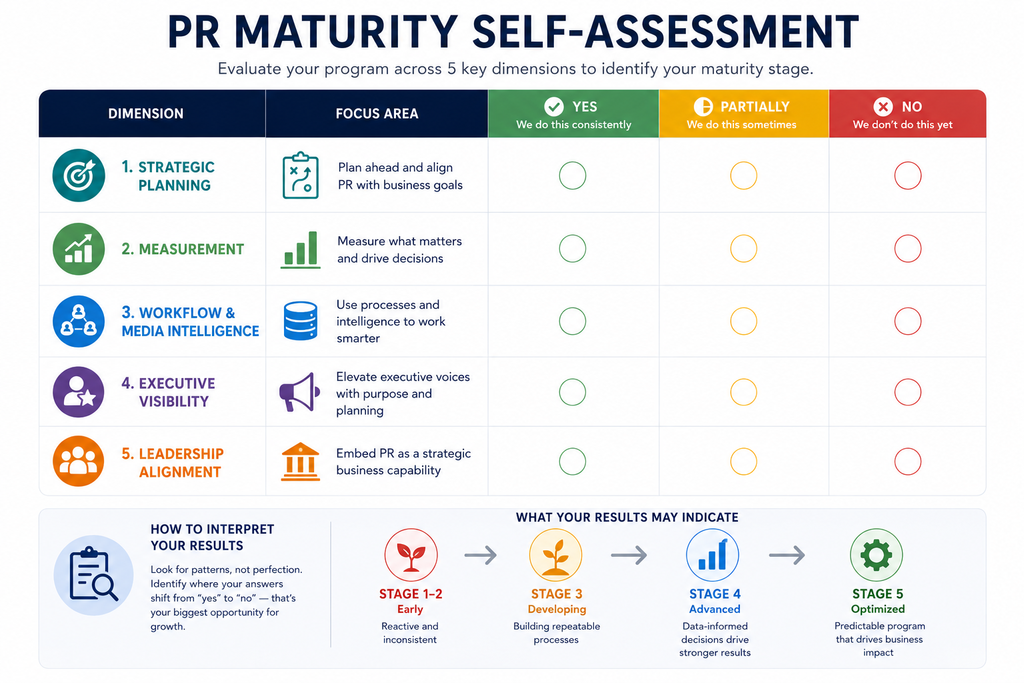
PR Maturity Self-Assessment: Evaluate These 5 Capabilities
Knowing the five stages is useful, but knowing where your organization actually stands is more valuable.
Use the questions below to identify strengths, expose capability gaps, and determine what may be preventing your PR program from reaching the next stage of maturity.
1. Strategic Planning
Ask whether your PR strategy is proactive, documented, and tied to business priorities:
- Do you maintain a PR roadmap beyond individual campaigns?
- Are earned media priorities aligned with company growth objectives?
- Do you have clearly defined narratives and messaging pillars?
- Can your team anticipate opportunities rather than constantly react to them?
2. Measurement
Mature measurement doesn’t just document what happened — it informs decision-making.
- Do you track KPIs beyond placements and impressions?
- Can you compare performance across campaigns and quarters?
- Does reporting show which narratives, journalists, or tactics perform best?
- Can leadership understand how PR supports broader business objectives?
3. Workflow and Media Intelligence
Take into account how much institutional knowledge your organization retains between campaigns:
- Are outreach, follow-up, and campaign workflows documented?
- Do you maintain a centralized record of journalist relationships and interactions?
- Can multiple team members access historical outreach and performance data?
- Does past campaign intelligence inform future targeting?
4. Executive Visibility
Executive thought leadership becomes increasingly systematic as PR programs mature.
- Do key executives have defined media positioning and areas of authority?
- Is executive visibility planned beyond major company announcements?
- Are speaking opportunities, commentary, and earned media coordinated?
- Can you evaluate which executive narratives resonate most effectively?
5. Leadership Alignment
Finally, evaluate whether PR has evolved from a communications activity into a strategic business capability:
- Does leadership understand what PR is expected to accomplish?
- Are communications priorities connected to company-level objectives?
- Does PR performance inform strategic conversations or resource decisions?
- Can the team clearly explain where additional investment would improve performance?
How to Interpret Your Results
Don’t treat PR maturity assessment as a pass-or-fail test.
Look for patterns.
- If you mostly answer “no,” your organization is likely operating closer to Stages 1–2.
- A mix of established processes and capability gaps often points toward Stage 3.
- Consistently answering “yes” — particularly around measurement, optimization, and business alignment — means your organization may be approaching Stages 4–5.
More importantly, pay attention to where your answers change from “yes” to “no.” Every new “no” reveals the capability your organization needs to strengthen next.
Pro Tip: If your answers reveal gaps across multiple capabilities — or you’re unsure which bottleneck is limiting performance — a formal PR Maturity Assessment can help benchmark your current operating model and prioritize the capabilities to build next.
Once you’ve identified your biggest capability gaps, formalize the next steps. Our PR Plan Guide explains how to translate business objectives, audiences, messaging, tactics, and measurement into a structured PR roadmap.
Moving from One Stage to the Next
PR maturity isn’t a speedrun to Stage 5. The goal along the way is to identify and systematically strengthen areas that have been preventing your program from reaching its next level.
Each level-up requires a new and different combination of:
- Strategy
- Process
- Measurement
- Organizational Alignment
Stage 1 to Stage 2: Replace Reaction with Planning
During the first transition, you’re creating structure, moving beyond pitching only when there’s news to planning campaigns around larger business goals.
During this transition:
- Build a quarterly PR calendar around business milestones and industry opportunities.
- Establish core narratives and messaging pillars.
- Create reusable, segmented media lists.
- Define basic campaign goals and KPIs.
- Document what worked after each campaign.
The key shift is from “What should we pitch right now?” to “What should we prepare for next?”
Stage 2 to Stage 3: Turn Campaigns into a Program
When you reach the second stage, structure exists — but it tends to disappear between campaigns. Getting to Stage 3 from here means connecting those individual initiatives into an always-on earned media program.
During this transition:
- Develop a longer-term earned media roadmap.
- Standardize outreach and follow-up workflows.
- Centralize journalist relationships and interaction history.
- Build ongoing executive thought leadership.
- Connect campaigns through consistent narratives.
- Establish program-level performance benchmarks.
The key shift is from running successful campaigns to building a repeatable communications capability.
Stage 3 to Stage 4: Turn Performance into Intelligence
Once you’ve achieved repeatable processes, the next step is optimization. Instead of just tracking what happened, Stage 4 is where performance data helps you determine what’s next.
During this transition:
- Compare results across campaigns and time periods.
- Track journalist engagement and response patterns.
- Evaluate narrative and message performance.
- Identify which outlets and opportunities generate strategic value.
- Build dashboards around decision-useful KPIs.
- Use findings to adjust targeting, timing, messaging, and resources.
The key shift is “How did we perform?” to “What should this performance change?”
Stage 4 to Stage 5: Build a Continuous Optimization System
The final transition isn’t about adding more tactics — it’s about building a PR optimization framework in which measurement continuously informs:
- Targeting
- Messaging
- Resource Allocation
- Strategy
During this transition:
- Integrate planning, media intelligence, execution, and reporting.
- Create regular optimization cycles.
- Preserve institutional knowledge across teams and partners.
- Align PR performance with executive and business priorities.
- Allocate resources based on strategic value and historical performance.
- Augment internal capabilities where specialized expertise or infrastructure accelerate performance.
This is where an optimization layer such as Intelligent Relations adds value — not by replacing internal teams or agency partners, but by helping your organization introduce greater performance discipline across your earned media program.
The key shift is from optimizing individual PR activities to continuously improving the entire PR system.
Build the Capability Before Adding Complexity
A major mistake organizations often make is trying to adopt Stage 4–5 tactics before establishing Stage 2–3 fundamentals. A sophisticated analytics platform can’t compensate for unclear messaging, and automation can’t fix poorly targeted outreach.
Think of the PR maturity model as a PR capability model — or capability ladder — where each level depends on foundational capabilities established below it.
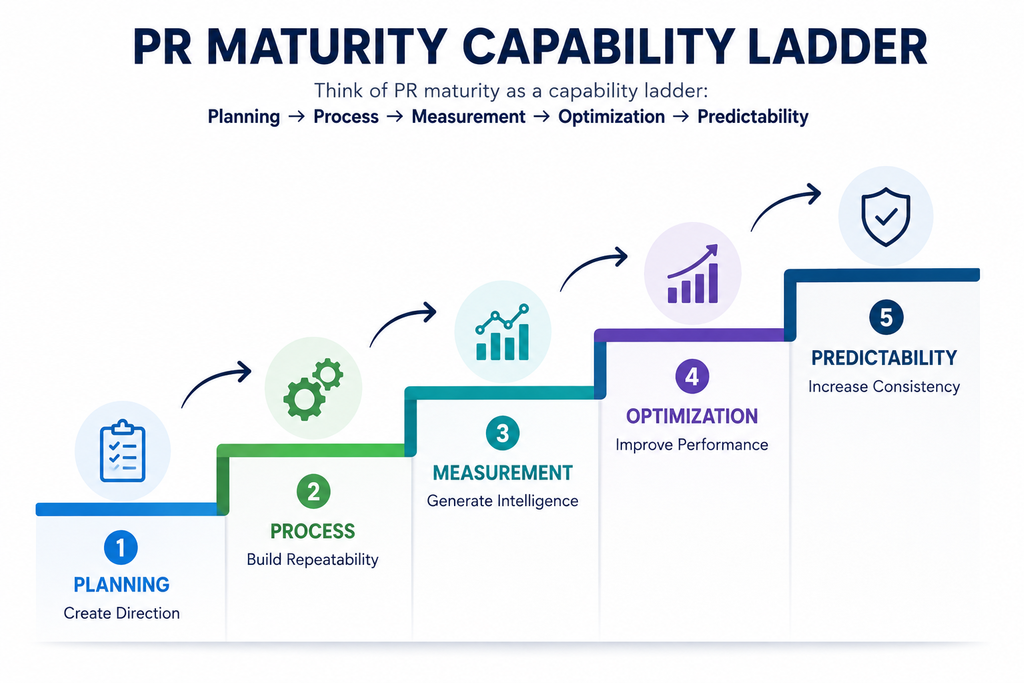
Each capability supports the one above it. Strengthening the foundation first makes advanced tech, analytics, and optimization considerably more valuable as your program grows.
Pro Tip: Before investing in the next tool, campaign, or partner, identify the capability your PR program is actually missing. The best next investment is usually the one that removes the bottleneck between your current maturity stage and the next — not the one that simply adds more activity.
Ready to turn PR performance into actionable intelligence? Explore our Earned Media Measurement Playbook to learn how stronger measurement helps your team optimize what works, improve decision-making, and connect earned media performance to business outcomes.
Technology & Workflow at Each Stage
Tech supports PR maturity, but it’s not a substitute for it. As your program evolves, the most valuable tools shift from basic outreach support to connected systems that:
- Preserve media intelligence.
- Streamline workflows.
- Measure Performance.
- Drive better decision-making.
Stage 1: Spreadsheets & Email
In the first stage, tech is primarily for executing individual tasks — spreadsheets for media lists, email for pitching, shared documents for campaign planning, etc.
Typical workflows include:
- Building Media Lists Manually
- Tracking Outreach in Spreadsheets
- Managing Follow-ups Through Individual Inboxes
- Saving Coverage in Documents or Folders
- Reporting Results Manually
These tools aren’t inherently problematic.
But the limitation is that information often becomes fragmented across people and platforms, making institutional knowledge difficult to preserve. The priority is to centralize the basics before adding complexity.
Stage 2: Media Lists & Campaign Tracking
As outreach becomes campaign-based, teams need better ways to:
- Manage Contacts
- Coordinate Activity
- Understand Campaign Performance
At this stage, tech begins supporting:
- Searchable Journalist Databases
- Shared Media Lists
- Campaign Calendars
- Outreach Tracking
- Coverage Monitoring
- Basic Performance Reporting
The workflow becomes more coordinated, but information may still live in separate systems.
One platform contains journalist data, another tracks coverage, and spreadsheets fill the gaps. The priority is to create visibility across campaigns and team members.
Stage 3: Centralized PR Operations
A structured earned media program requires more than a collection of tools — it requires a centralized operating environment where media intelligence and campaign history accumulate over time.
Capabilities include:
- Media CRM and Relationship History
- Standardized Campaign Workflows
- Centralized Messaging and Narrative Intelligence
- Executive Visibility Tracking
- Integrated Media Monitoring
- Historical Campaign Benchmarks
Aim to create a shared source of intelligence so every new campaign builds on what the organization already knows. The priority is to preserve institutional knowledge and make workflows repeatable.
Stage 4: Analytics & Performance Dashboards
At this level, the maturity model also functions as a PR performance framework, helping teams connect campaign data with future decisions.
PR workflows increasingly incorporate:
- Journalist Engagement and Response Data
- Narrative Performance Analysis
- Coverage Quality Metrics
- Competitive and SOV Benchmarks
- Executive Dashboards
- Business-aligned KPIs
- Regular Performance Reviews
Instead of reviewing analytics only at the end of a campaign, teams create feedback loops where valuable insights continuously inform:
- Targeting
- Messaging
- Timing
- Resource Allocation
The priority is to turn reporting into decision-making intelligence.
Stage 5: Integrated Earned Media Intelligence
At the highest maturity level, tech connects the PR operating system rather than just supporting individual tasks. Planning, media intelligence, execution, measurement, and optimization are all part of a continuous workflow.
For an enterprise PR strategy, this integration becomes especially important as more teams, executives, markets, agencies, and campaigns enter the operating model.
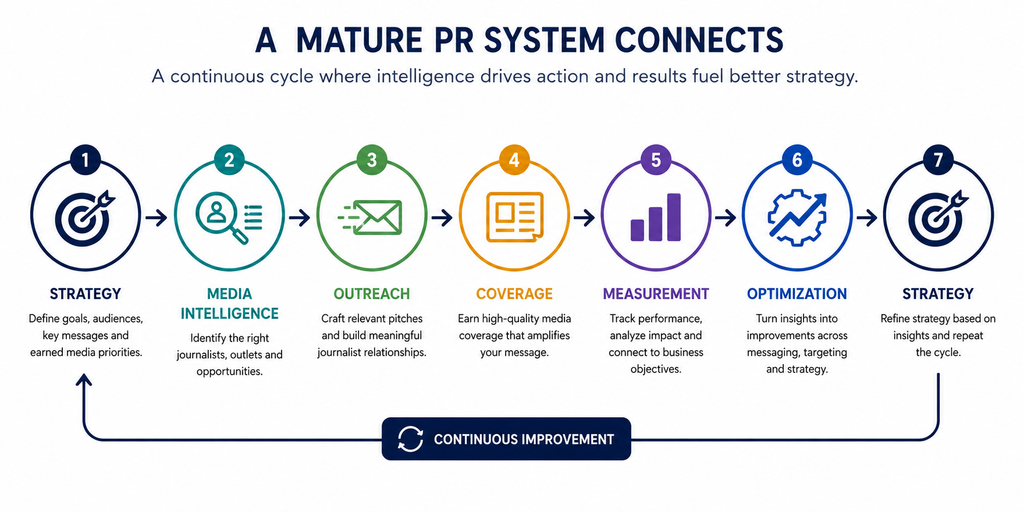
Automation reduces repetitive work, while centralized intelligence helps communications leaders identify opportunities and allocate resources more effectively.
Human judgment, however, remains essential — particularly for:
- Building Relationships
- Developing Narratives
- Positioning Execs as Thought Leaders
- Making Strategic Decisions
This is also where an augmentation partner functions as an optimization layer, helping established teams:
- Connect fragmented processes.
- Improve performance intelligence.
- Introduce greater structure without replacing the people or partners already driving the program.
The priority is to connect the system so intelligence compounds over time.
Don’t Let Your Tech Stack Outpace Your PR Maturity
More sophisticated tech doesn’t automatically create a more sophisticated PR program.
Adding AI, automation, analytics, or additional platforms before you’ve established a clear strategy and workflow will only make an inefficient system operate faster. The best tech investments solve a specific maturity bottleneck.
- Stage 1 teams may need centralization.
- Stage 3 teams may need better performance intelligence.
- Stage 4 teams may need integration.
Start with the capability gap, then make the right tech choices.
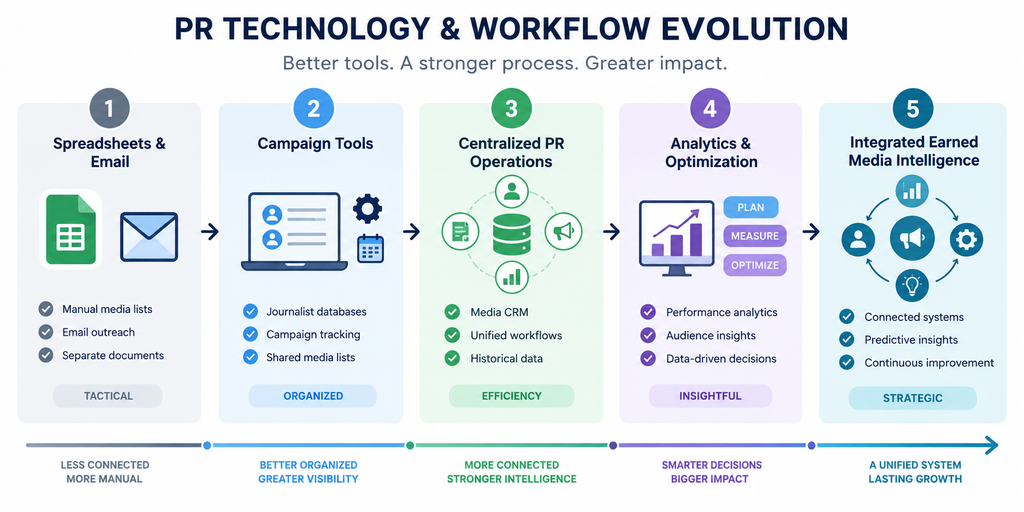
Pro Tip: Audit your PR tech by asking what decision, workflow, or capability each tool improves. If a platform creates more data but doesn’t help your team plan, execute, measure, or optimize more effectively, it may be adding complexity rather than maturity.
As PR technology evolves, the underlying media relationships still matter. Explore our Media Relations Guide to learn how structured journalist research, outreach, relationship building, and measurement work together to create stronger earned media performance.
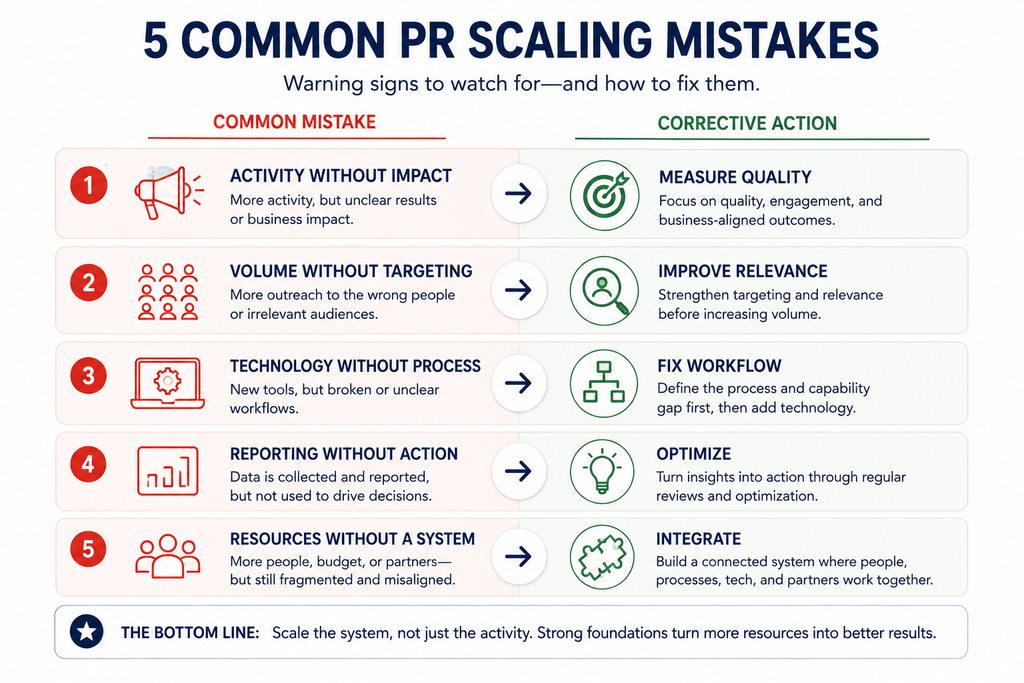
5 Common PR Scaling Mistakes
Scaling PR needs more than just increasing budgets, outreach, or campaign volume. If you lack stronger systems beneath growth, your organization may end up scaling inefficiency instead of performance.
Watch out for these top five mistakes as your program climbs the PR maturity ladder.
1. Confusing Activity with Progress
More pitches, press releases, campaigns, and media contacts make a PR program look highly productive, but that doesn’t mean it’s actually more effective.
Mature teams evaluate whether activity is improving outcomes such as:
- Journalist Response and Engagement
- Coverage Quality and Relevance
- Narrative Penetration
- Executive Visibility
- Business-aligned PR Performance
Fix this by establishing KPIs that measure activity quality and impact — not just how much activity occurred.
2. Scaling Outreach Before Improving Targeting
When results start to plateau, ramping up pitching seems like the solution. But increasing untargeted outreach usually makes the underlying problem worse.
Before scaling, teams need to know which journalists, outlets, topics, and narratives consistently generate engagement. That intelligence allows teams to make outreach more precise as the program grows rather than simply increasing volume.
Fix this by improving journalist segmentation and relevance before increasing outreach volume.
3. Adding Technology Without Fixing the Workflow
New platforms might improve efficiency, but they won’t make up for:
- Unclear Responsibilities
- Fragmented Processes
- Inconsistent Execution
A sophisticated media database won’t solve weak targeting, AI won’t fix an unclear narrative, and an analytics dashboard offers limited value if teams fail to use its insights to refine strategy.
Fix this by defining the workflow and capability gap first, then select the best tech to solve it.
4. Measuring PR Without Using the Data
Some organizations develop sophisticated PR reporting programs but stay operationally immature because reporting ends with the presentation.
Dashboards need to do more than tell leadership what happened. They should help teams decide:
- Which narratives deserve greater investment?
- Which journalists are becoming valuable relationships?
- Which campaigns consistently outperform benchmarks?
- Where should resources shift next quarter?
Fix this by building regular optimization reviews into the PR workflow so reporting is more actionable.
5. Scaling Resources Without Building a System
Expanding capacity alone through increased hiring, agency support, or budgets doesn’t create maturity.
Additional resources typically create more fragmentation without:
- Shared Processes
- Centralized Intelligence
- Consistent Measurement
- Clear Strategic Priorities
Internal teams, agencies, technology providers, and specialized partners need to operate within a common framework — not as disconnected execution layers.
Fix this by building an operating system that clarifies how people, processes, technology, and partners work together before any major resource expansions.
Scale the System, Not Just the Activity
The common thread across these mistakes is this: PR maturity must keep pace with PR investment. As programs grow, the infrastructure supporting strategy, execution, intelligence, and measurement needs to grow with them.
That’s how additional resources improve performance instead of simply increasing activity.
Pro Tip: Before expanding your PR budget, team, or technology stack, identify what would happen if activity doubled tomorrow. If your workflows, intelligence, or measurement systems couldn’t support that growth, strengthen the infrastructure first.
Find more resources on PR mistakes to avoid here:
What Predictable Earned Media Actually Looks Like
Predictable earned media is about confidence, not certainty. It means building a disciplined PR system that makes strong outcomes more repeatable through:
- Better Planning
- Stronger Relationships
- Clearer Measurement
- Continuous Optimization
Repeatable Planning Cycles
Don’t wait for news to happen. Maintain rolling plans that connect:
- Business Priorities
- Industry Moments
- Executive Visibility
- Proactive Media Opportunities
Instead of relying on occasional milestones, this creates a steady pipeline of potential stories.
Predictable planning includes:
- Quarterly and Monthly Communications Priorities
- Defined Narrative Themes
- Planned Executive Commentary
- Tentpole Industry Opportunities
- Flexible Capacity for Breaking News
It’s a fine line. You want to avoid scheduling that becomes too rigid while ensuring the team is always fully aware of what it’s trying to accomplish next.
Stronger, More Durable Media Relationships
Predictability also comes from building meaningful media relationships.
Instead of rebuilding media lists for every campaign, mature teams have already answered these key questions:
- Which journalists cover my space?
- What topics interest them?
- How have previous interactions performed?
- Where are genuine relationships developing?
That accumulated intelligence not only streamlines future outreach but also makes it more relevant with each campaign.
More Consistent Executive Visibility
Don’t let executive visibility vanish between funding announcements, launches, or major company milestones.
Create recurring opportunities for leaders to contribute:
- Expert Commentary
- Bylined Thought Leadership
- Interviews
- Trend Analysis
- Event Participation
- Reactive Commentary on Timely Industry Developments
Over time, that consistency strengthens executive authority and makes your organization a more recognizable resource for reporters.
Data-Informed Decision Making
Another goal is to understand which parts of your strategy are producing meaningful results.
Mature teams have answers to:
- Which narratives generate journalist interest?
- Which outlets provide strategically valuable coverage?
- Which executives or subject-matter experts gain traction?
- Which campaign types outperform benchmarks?
- Where outreach or messaging needs adjustment?
Now, this doesn’t totally remove uncertainty, but it does significantly reduce unnecessary guesswork.
Continuous Optimization
What happens after reporting is one of the strongest indicators of maturity.
Instead of filing away campaign results, use that performance intelligence to refine the next planning cycle.
This leads to:
- Sharper Targeting
- More Relevant Messaging
- Better Resource Allocation
- Adjustment or Removal of Underperforming Tactics
These incremental improvements compound over time.
Predictability Is Confidence, Not Certainty
PR maturity’s real benefit isn’t knowing exactly which journalist will cover your next story — it’s having more confidence in the system producing those opportunities.
And over time:
- Leadership gains clearer expectations.
- Communications teams gain better visibility into performance.
- Budget decisions become more informed.
- Earned media becomes less dependent on isolated wins.
That’s what predictable PR actually looks like. It’s not guaranteed coverage, but rather a repeatable system continuously refined to compound the probability, quality, and strategic value of earned media.
Pro Tip: Measure predictability by the stability of your PR operating system — not by whether placement counts remain identical every month. Consistent planning, journalist engagement, reporting, and optimization are stronger maturity signals than perfectly steady coverage volume.
Predictable PR also requires reporting that helps leadership understand what performance means and what should happen next. Read our PR Reporting for Boards guide for a framework that connects earned media activity to strategic business decisions.
Aligning PR Maturity with Revenue Growth
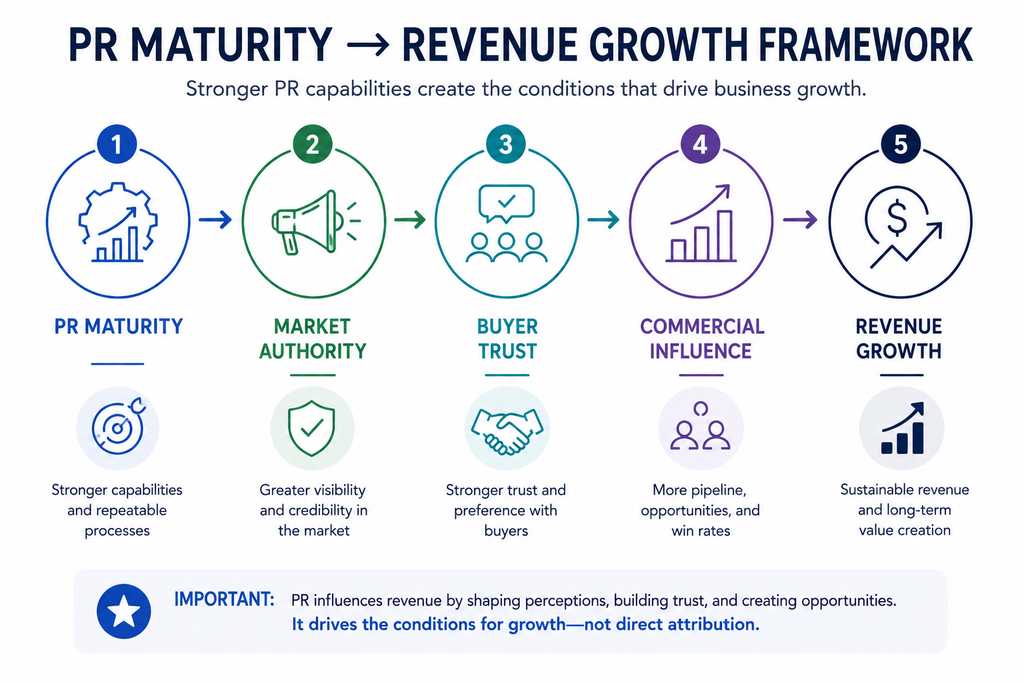
PR maturity isn’t about turning communications into a direct-response sales channel. You’re building a more advanced program to support the conditions that drive growth:
- Greater Market Credibility
- Stronger Executive Authority
- Increased Buyer Confidence
- Better Alignment with Business Priorities
For PE-backed companies, PR maturity also creates greater operating discipline by helping communications leaders:
- Establish clearer performance expectations.
- Preserve institutional knowledge across leadership changes.
- Align PR investment with value-creation priorities.
- Give portfolio leadership better visibility into where communications resources are creating strategic value.
Supporting Sales
Earned media often impacts revenue before prospects ever speak with sales. Strategic coverage reinforces credibility throughout the buying process by helping prospects::
- Research a company.
- Validate claims made elsewhere in the funnel.
- Encounter third-party proof points that reinforce sales conversations.
As PR matures, coordinate earned media more closely with:
- Priority Markets and Customer Segments
- Product and Category Narratives
- Sales Enablement Content
- Strategic Accounts
- Major Launches and Growth Initiatives
You’re not trying to tie every deal to a single placement — you’re gaining insight into where earned media creates a more credible environment for conversion.
Building Market Trust and Authority
Consistent, high-quality coverage creates cumulative authority.
When buyers repeatedly encounter a company or its executives in credible industry conversations, earned media reinforces:
- Awareness
- Expertise
- Trust
Deliberately build that authority around the topics and markets that matter most to your company’s growth strategy. This makes PR less about wide visibility and more about strategic credibility.
Strengthening Executive Influence
Leadership visibility becomes a valuable business asset for growth-stage and enterprise organizations.
Having a structured executive thought leadership program in place helps leaders establish authority around:
- Emerging Trends
- Market Changes
- Customer Challenges
- Category Narratives
And that visibility often supports more than media relations — it also strengthens conversations with customers, investors, partners, talent, and other stakeholders. As PR maturity increases, executive visibility shifts from an interview here and there to a coordinated, long-term positioning strategy.
Making Smarter Investment Decisions
Mature PR programs also give leadership more actionable information about where communications resources create value.
Instead of asking, “How much coverage did we get?” you begin answering:
- Which narratives support strategic priorities?
- Which markets and audiences respond?
- Which executives generate meaningful engagement?
- Which campaigns create valuable downstream opportunities?
- Where is additional PR investment justified or unnecessary?
This makes PR reporting more useful for budgeting, planning, and resource allocation.
Connecting PR Performance to Business Outcomes
At the highest levels of maturity, communications and business performance are measured in the same arena. Reasonable connections are established between earned media and indicators such as:
- Branded Search
- Website Engagement
- Inbound Interest
- Sales Conversations
- SOV
- Category Authority
- Recruiting
- Investor Visibility
- Pipeline Influence
Influence is the name of the game. PR rarely operates alone, so mature measurement avoids making hard-to-prove attribution claims. Instead, it shows how earned media adds to the broader growth system.
Visualize it this way:
PR Maturity Creates Strategic Leverage
Ultimately, the main value of a mature PR program lies in scaling earned media capabilities your organization uses to support its changing business priorities.
- Does a new market need credibility? PR has the infrastructure to build it.
- Does an executive need greater category authority? The positioning system already exists.
- Does leadership need to understand what’s working? Performance intelligence is available.
This is where PR proves it’s more than just output — it’s strategic leverage for growth.
Pro Tip: Start with the business objective and work backward. Define the behavior, perception, or audience outcome PR needs to influence, then choose the narratives, media opportunities, and KPIs that support it.
Want to see how earned media fits into the broader growth engine? Our Paid vs. Earned Media Strategic Investment Guide explores how earned credibility works alongside paid, owned, and shared media to strengthen trust, conversion efficiency, and long-term growth.
PR Maturity Is Built, Not Bought
You don’t build PR maturity by simply adding another tool, launching more campaigns, or increasing the budget.
A mature PR program is built by strengthening the systems behind the work:
- Strategy
- Media Intelligence
- Repeatable Processes
- Meaningful Measurement
- Continuous Optimization
Earned media will always depend on journalists, news cycles, and factors beyond your control, so don’t worry about achieving perfect predictability.
The advantage of PR maturity is greater confidence in the system. This means not only having a firm grasp on what you’re trying to accomplish and what drives performance but also where resources create value and how each campaign informs the next.
It takes time to reach Stage 5. Just figure out where you are, what’s holding you back, and which capabilities to build next.
Ready to find your next step? Book a free consultation with us today to assess your current PR maturity, uncover performance gaps, and build a more structured, measurable, and scalable earned media program. Start with a PR Maturity Assessment or PR Efficiency Audit to identify where your program needs improvement — and what it takes to reach the next stage.