
How to Evaluate a PR Agency: The Ultimate Framework & Selection Guide [Examples + Tips]
Your PR agency is working hard. But is PR actually working? That question becomes harder to answer when monthly reports are packed with metrics that present activity without necessarily proving impact. Throw a strong agency relationship into the mix,...
- Home
- Intelligent Insights Blog
- How to Evaluate a PR Agency: The Ultimate Framework & Selection Guide [Examples + Tips]

Your PR agency is working hard. But is PR actually working?
That question becomes harder to answer when monthly reports are packed with metrics that present activity without necessarily proving impact. Throw a strong agency relationship into the mix, and evaluating performance objectively gets more complicated.
The fix isn’t to pass harsh judgement on your agency after one disappointing quarter. Nor is it to assume a series of placements means everything is going well.
Learning how to evaluate a PR agency objectively starts with evaluating the entire PR system.
A structured PR agency evaluation looks beyond volume to examine:
- Strategic Alignment
- Coverage Quality
- Journalist Engagement
- Narrative Pull-through
- Reporting Maturity
- Connection to Business Outcomes
In this guide, we’ll provide you with a practical framework for separating activity from impact, identifying gaps in performance, and deciding whether your program needs optimization, augmentation, or a bigger change.
- Why Evaluating PR Agencies Is So Difficult
- The 5 Dimensions of PR Agency Performance
- Performance Benchmarks: What “Good” PR Performance Actually Looks Like
- Questions Every CMO Should Ask Their PR Agency
- Red Flags vs. Growth Signals
- How to Conduct a PR Agency Performance Audit
- When to Optimize vs. When to Replace Your PR Agency
- How Augmentation Improves Agency ROI
Why Evaluating PR Agencies Is So Difficult
PR agencies are hard to evaluate because PR isn’t a simple input-output equation. An increased amount of pitches, placements, or impressions doesn’t automatically mean an agency is creating meaningful value. Performance depends on everything from strategy and narrative strength to journalist interest, market timing, and internal execution.
So evaluating PR agency performance is really less about finding the perfect KPI and more about understanding how the system functions as a whole.
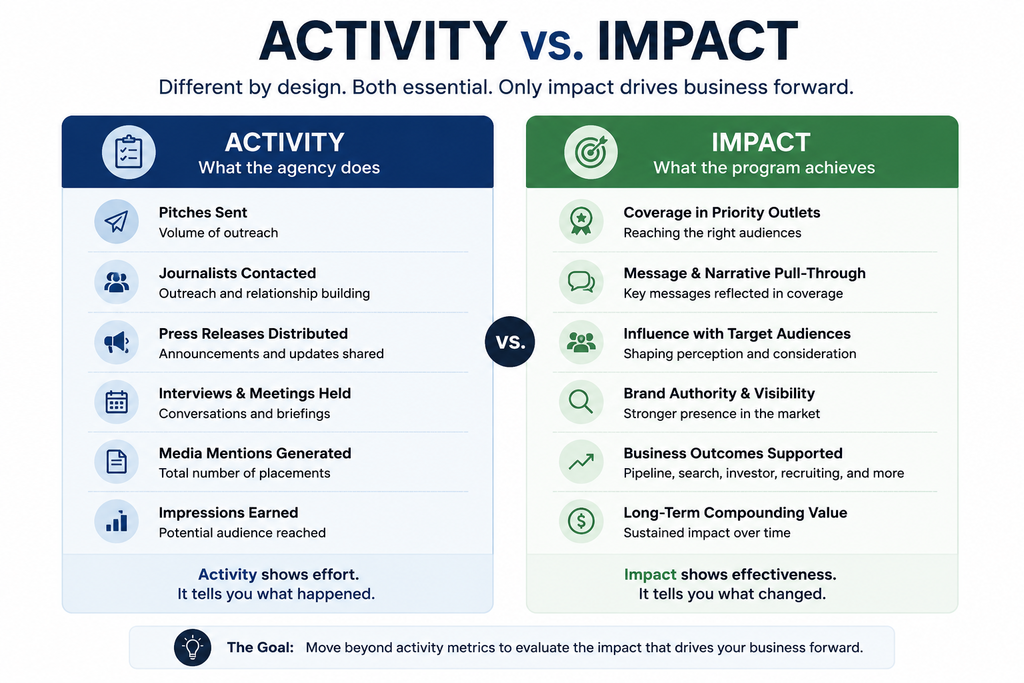
Activity Is Easier to Measure Than Impact
Most agencies report what happened during the month:
- Pitches Sent
- Journalists Contacted
- Press Releases Distributed
- Interviews Secured
- Media Mentions Generated
- Impressions Earned
While these metrics still have value, they only show that work is happening. But activity isn’t a substitute for effectiveness.
Example: Sending hundreds of pitches isn’t necessarily better than sending 25–50 highly targeted ones. And 20 mentions in low-relevance publications may contribute less strategic value than a few placements that actually reach your target audience.
Think of it this way:
- Activity answers, “What did we do?”
- Performance asks, “Did it actually work?”
PR Performance Has Multiple Variables
Flawless agency execution still can’t manufacture newsworthiness or guarantee coverage.
Results are influenced by factors such as:
- Narrative Strength
- Executive Availability
- Market Timing
- Competitive Activity
- Brand Authority
- Internal Approval Speed
- Journalist Priorities
- News Cycle Volatility
For this reason, disappointing coverage shouldn’t be immediately viewed as PR underperformance.
Instead, start with results and work backwards. If journalists aren’t responding, ask yourself these questions:
- Is targeting weak?
- Is the pitch ineffective?
- Is the narrative failing to differentiate the company?
- Is the market simply focused elsewhere?
The priority is to identify the issues — not assign blame.
Satisfaction Isn’t the Same as Performance
Agency relationships matter.
Productive partnerships are built on:
- Responsiveness
- Communication
- Collaboration
- Enthusiasm
- Trust
But great relationships still flourish with mediocre performance.
Conversely, demanding agencies may challenge internal assumptions, push executives toward stronger narratives, or recommend changes that yield great results.
Since satisfaction is subjective, it should be one evaluation input but not the evaluation framework itself.
Evaluate the PR System, Not Just the Placements
A more useful PR agency evaluation looks deeply at how value moves through the entire program.
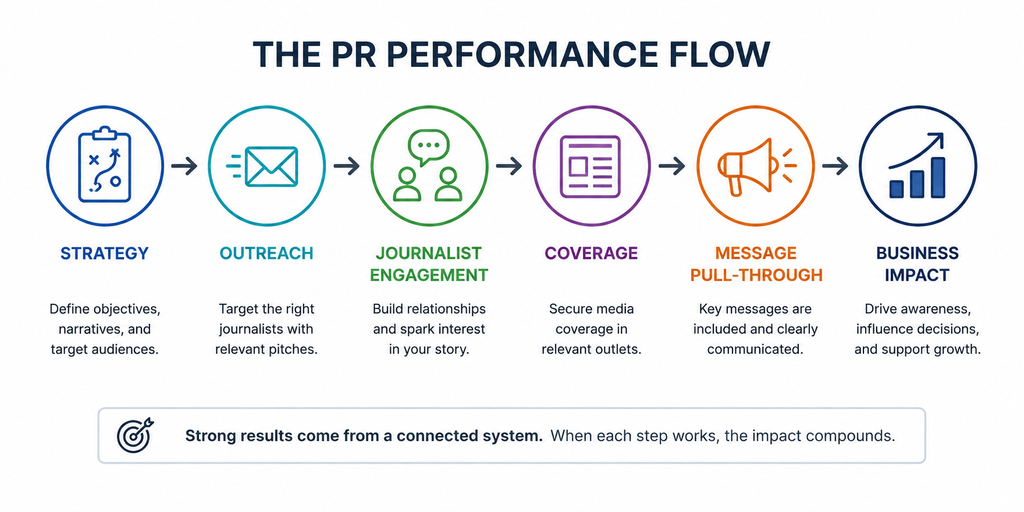
A weak link anywhere in that chain affects the final outcome.
Example: Poor coverage may start with targeting or positioning rather than execution alone. Evaluating the whole system makes it easier to distinguish between an agency problem, a strategy issue, and a capability gap — and determine what actually needs to change.
Pro Tip: Evaluate the system before evaluating individual outcomes. A coverage problem may actually originate with positioning, targeting, narrative strength, or internal execution bottlenecks.
Use our PR Efficiency Audit guide to dig deeper into the workflows, performance gaps, and inefficiencies that may be limiting PR results.
The 5 Dimensions of PR Agency Performance
Once you’re no longer treating placements as the end-all success metric, the question becomes what to evaluate instead. A useful PR agency evaluation framework examines five interconnected performance dimensions.
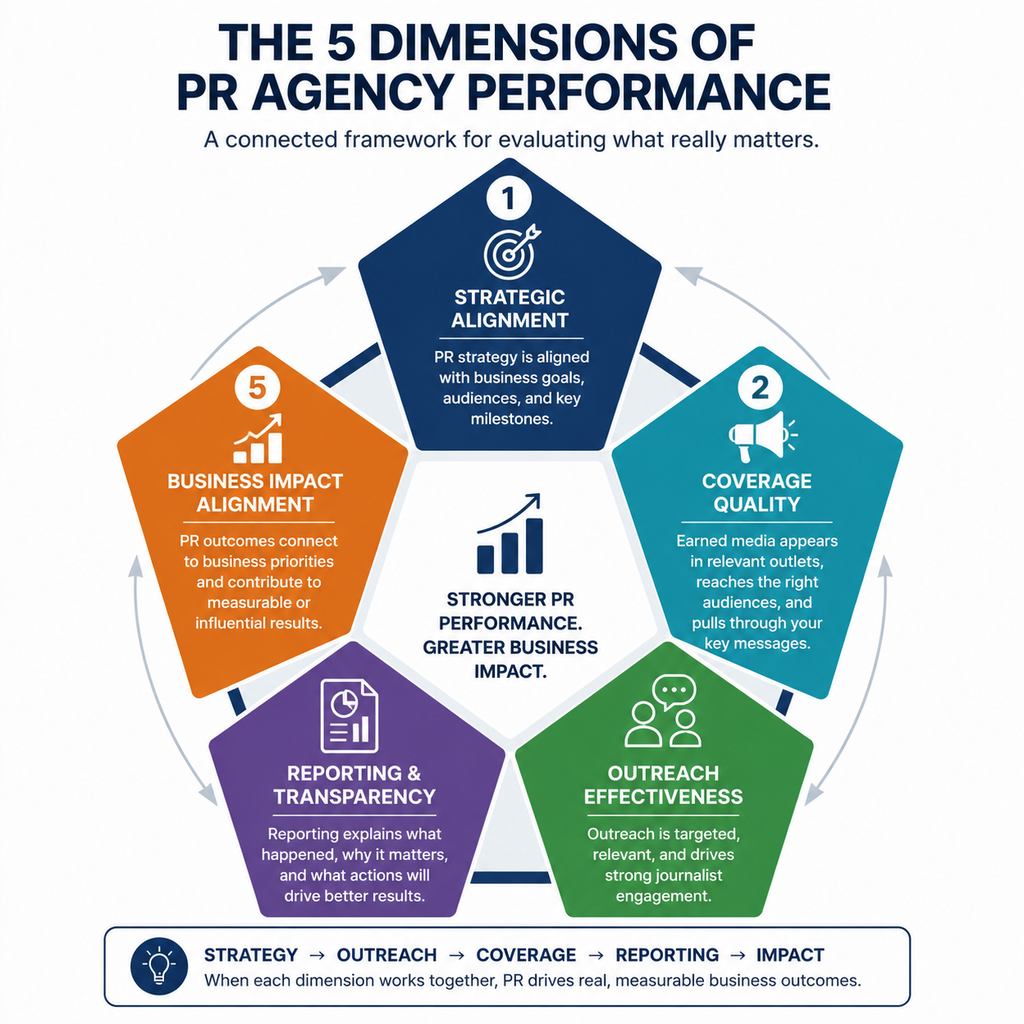
1. Strategic Alignment
Before sending out a single pitch, your agency should understand where the business is headed and build its earned media strategy accordingly.
Evaluate how well PR aligns with:
- Business Priorities
- Growth Objectives
- Target Audiences
- Competitive Positioning
- Executive Visibility Goals
- Product and Market Milestones
Example: If your company is preparing for international expansion, generating more domestic mentions may look good in a report but does little to support the actual objective.
Key Performance Question: “Is our PR strategy driven by business priorities — or simply opportunities to generate coverage?”
2. Coverage Quality
Media mentions vary in strategic value.
It’s not about how much coverage an agency generated — it’s about where the company appeared, who the coverage reached, and what it communicated.
Look at factors such as:
- Publication Relevance
- Audience Fit
- Journalist Authority
- Message Prominence
- Narrative Pull-Through
- Executive Inclusion
- Competitive Positioning
Example: Agency A generates 20 mentions across loosely relevant publications. Agency B secures five placements in outlets read by your buyers, investors, and industry stakeholders. Those five placements also reinforce priority narratives, so the smaller number represents significantly stronger performance.
Key Performance Question: “Is our coverage reaching the audiences that influence business outcomes?”
3. Outreach Effectiveness
Outreach volume tells you how many pitches were sent. Journalist engagement tells you if those pitches worked.
Useful indicators include:
- Journalist Response Rate
- Positive Response Rate
- Pitch-to-Interview Rate
- Pitch-to-Placement Rate
- Repeat Journalist Engagement
- Performance by Pitch or Narrative
These metrics expose problems hidden by placement totals alone.
Example: A declining response rate might signal weak targeting, stale narratives, poor timing, or low pitch relevance. More outreach shouldn’t be the go-to solution. Strong agencies gain insights from journalist behavior and use that intelligence to refine outreach strategy.
Key Performance Question: “Are journalists consistently engaging with our agency’s narratives, experts, and pitches?”
4. Reporting & Transparency
A PR report needs to do more than show how busy the agency has been.
Mature PR reporting helps leadership answer:
- What happened?
- Why did it happen?
- What does it mean?
- What is/isn’t working?
- What should change next?
That requires visibility into both successes and underperformance. Meaningful PR reporting should:
- Identify performance trends.
- Explain campaign results.
- Connect metrics to objectives.
- Recommend specific optimization actions.
Example: If every monthly report applauds impressions and placements without explaining what that data means, leadership has information but little actionable intelligence.
Key Performance Question: “Does our reporting help us make better PR decisions?”
5. Business Impact Alignment
The final dimension connects PR performance to leadership’s priority outcomes.
Depending on your objectives, those may include:
- Brand Authority
- Executive Visibility
- Category Positioning
- Sales Enablement
- Branded Search
- Website Engagement
- Investor Confidence
- Recruiting
- Pipeline Influence
Not every PR outcome can — or should — be tied directly to revenue.
Example: Assisted impact generated by your company’s always-on earned media strategy continuously influences awareness, credibility, consideration, and decision-making across a longer buyer journey. Rather than force attribution where it doesn’t exist, you establish a credible connection between PR objectives and business priorities.
Key Performance Question: “Can our agency explain how earned media supports the company’s broader growth objectives?”
PR Agency Evaluation Scorecard
Use a simple 1–5 score to establish a baseline and identify where deeper evaluation is needed.
| Dimension | What to Evaluate | Example KPIs | Score |
| Strategic Alignment | Connection to business priorities | Strategic objective alignment, narrative consistency | 1–5 |
| Coverage Quality | Relevance and authority | Target publication rate, message pull-through | 1–5 |
| Outreach Effectiveness | Journalist engagement | Response rate, interview conversion | 1–5 |
| Reporting and Transparency | Decision usefulness | KPI visibility, insights, optimization actions | 1–5 |
| Business Impact Alignment | Connection to growth | Visibility, authority, assisted conversions | 1–5 |
Note: The total isn’t a pass/fail grade. True value lies in seeing where performance is strongest, where gaps exist, and whether those gaps improve over time.
Example: If your company is focused on fundraising, you might weigh executive visibility and investor-relevant coverage differently than an enterprise that’s prioritizing category leadership.
Pro Tip: Don’t let one standout metric make up for weaknesses everywhere else. Sustainable PR performance comes from a connected system in which strategy, outreach, coverage, measurement, and business objectives reinforce one another.
Recommended Reading: The PR Maturity Model: From Ad Hoc Outreach to Predictable Coverage
Performance Benchmarks: What “Good” PR Performance Actually Looks Like
Unfortunately, there isn’t one universal number that separates a high-performing program from an underperforming one.
Results vary by:
- Industry
- Company Maturity
- Brand Authority
- Campaign Type
- News Cycle
- Targeted Journalists
PR agency performance metrics are more useful when they combine relevant external benchmarks with your own historical baseline.
Hitting some arbitrary number isn’t the goal. The goal is determining whether performance is becoming more strategic, efficient, and predictable over time.
Coverage Quality Benchmarks
Look beyond total placements.
Strong coverage should consistently appear in relevant outlets and reinforce the narratives your company wants to own.
Track indicators such as:
- Priority Outlet Coverage
- Target Audience Relevance
- Message Pull-Through
- Executive Quote Inclusion
- Competitive Positioning
- Repeat Coverage in Strategic Publications
Example: If your coverage volume increases 30% but most new placements fall outside of your targeted media list, the improvement just looks good on paper but will likely yield little strategic impact.
The opposite is also true.
Flat placement volume paired with stronger outlets and better message pull-through represents genuine progress.
Outreach Effectiveness Benchmarks
One of the clearest signals of whether your outreach strategy is working (or not) is journalist behavior.
Useful benchmarks include:
- Journalist Response Rate
- Positive Response Rate
- Pitch-to-Interview Conversion
- Pitch-to-Placement Conversion
- Repeat Journalist Engagement
- Performance by Narrative or Pitch Type
This doesn’t mean you should obsess over a single response-rate target.
Instead, compare results across:
- Campaigns
- Narratives
- Journalist Segments
- Time Frames
Example: You send out 100 highly relevant pitches and generate 15 meaningful responses. A competitor sends 500 broad pitches and generates the same 15. Your approach is way more efficient — even though the final response count is identical. You’ve also started building a rapport with more relevant journalists for improved future outreach.
Efficiency Benchmarks
“What are we getting for the resources we’re investing?” This is an important question often overlooked by traditional PR reporting.
Depending on your program, measure:
- Cost per Strategic Placement
- Cost per Journalist Response
- Coverage per Campaign
- Time-to-Placement
- Outreach-to-Coverage Conversion
- Resource Allocation by Campaign
- Performance by Journalist Segment
Now, these metrics in no way mean agencies should chase the cheapest possible coverage. But they should help leadership identify where time, budget, and outreach effort are generating the greatest strategic return.
Reporting Maturity Benchmarks
Good reporting evolves with maturing PR programs.
A useful progression looks like this:
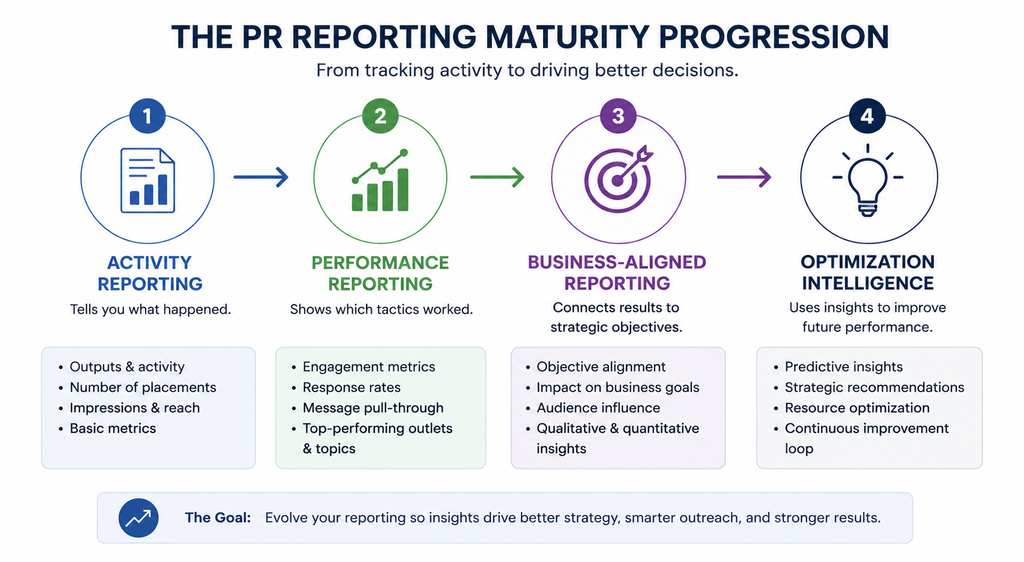
At the activity stage:
- Reporting tells you what happened.
- Performance reporting shows which tactics worked.
- Business-aligned reporting connects those results to strategic objectives.
At the most mature level:
- Reporting becomes optimization intelligence.
- Historical data actively informs targeting, narratives, resource allocation, and future campaign decisions.
That distinction is crucial when determining how to measure PR agency effectiveness. The best reporting system doesn’t just document performance — it improves it.
What Improving PR Performance Looks Like
Let’s say you’re a growth-stage B2B tech company evaluating two consecutive six-month periods:
| Metric | Previous Period | Current Period | What Changed |
| Priority Outlet Coverage | 38% | 57% | More coverage reached strategic audiences |
| Journalist Response Rate | 9% | 14% | Targeting and pitch relevance improved |
| Message Pull-through | 46% | 68% | Priority narratives appeared more consistently |
| Repeat Journalist Engagement | 12 | 19 | Media relationships strengthened |
| Outreach-to-Coverage Conversion | 4% | 7% | Outreach became more efficient |
These figures are illustrative, not universal PR benchmarks. What matters is the pattern:
- Better-quality Coverage
- Stronger Engagement
- Clearer Narrative Adoption
- Improved efficiency
That gives leadership a more useful answer to whether an agency is working than placement volume alone.
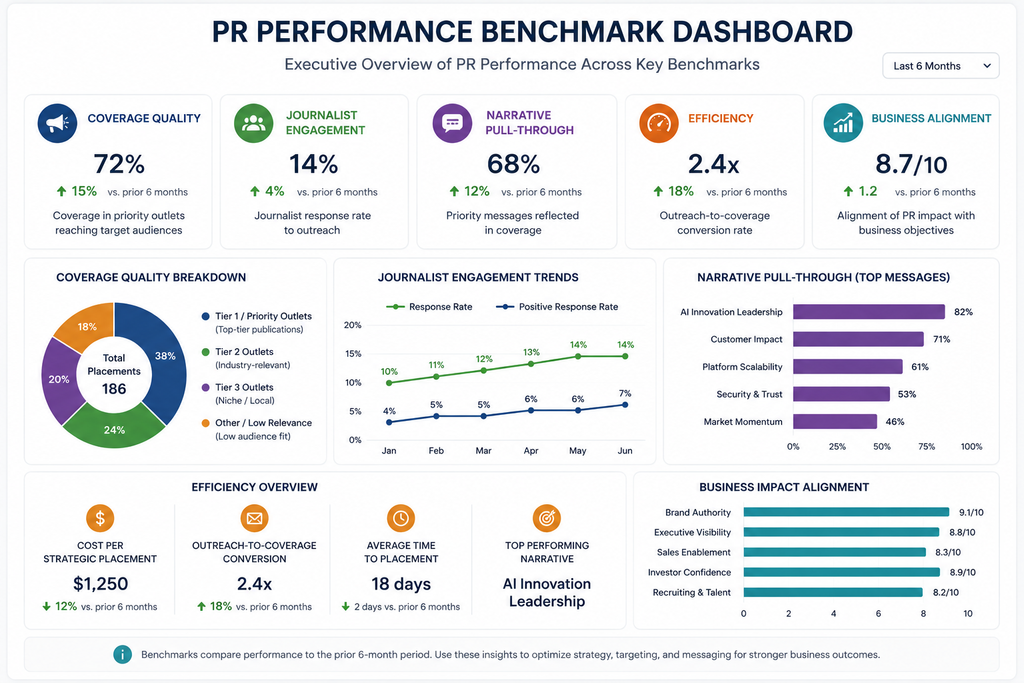
Pro Tip: Your strongest benchmark is often your own historical performance. Look for improving efficiency, stronger journalist engagement, better message pull-through, and increasing strategic coverage over time.
For additional metrics you can use to build a more complete view of PR performance, read our guide: 10 Best PR Metrics to Measure for Increased Success
Questions Every CMO Should Ask Their PR Agency
A truly good PR agency review won’t feel like an interrogation.
It will create a strategic conversation that answers:
- What’s working?
- What’s changing?
- Where can performance improve?
For CMOs and communications leaders, the right questions reveal a lot more than pages of vanity metrics. They show whether your agency understands your business, learns from performance data, and has a clear vision behind its decisions.
Use this PR agency evaluation checklist during quarterly reviews, planning sessions, or performance audits:
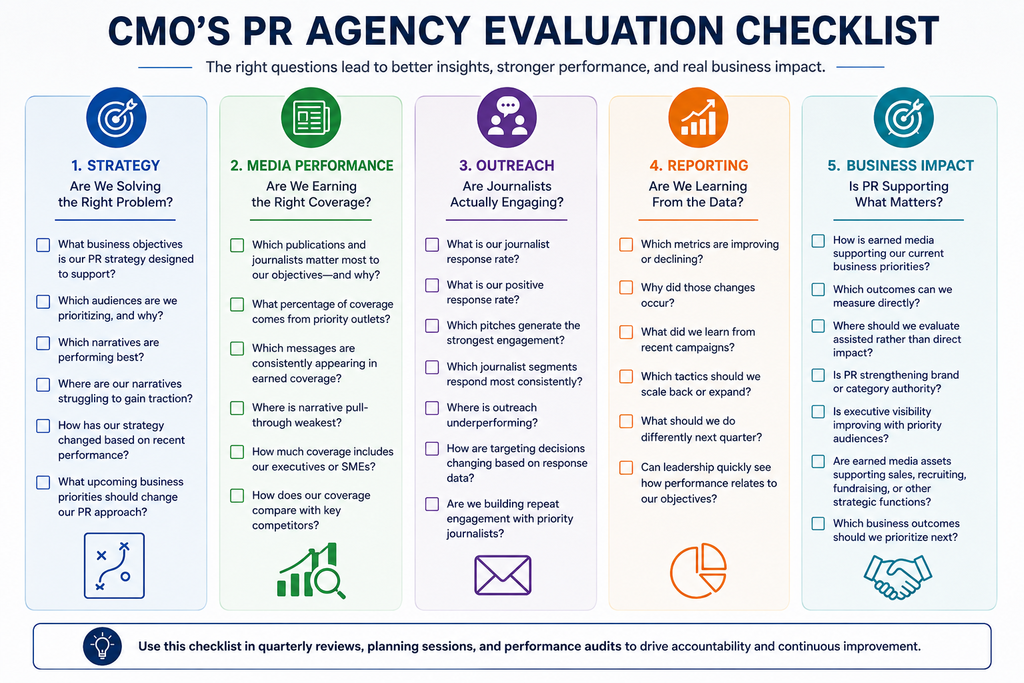
1. Strategy: Are We Solving the Right Problem?
Before you even talk about placements, make sure the agency’s strategy still reflects where the business is headed.
Ask these key questions:
- Which audiences are we prioritizing, and why?
- Which narratives are performing best?
- Where are our current narratives struggling to gain traction?
- How has our strategy changed based on recent performance?
- What upcoming business priorities should change our PR approach?
- What business objectives is our current PR strategy designed to support?
Strong answers should demonstrate more than familiarity with the PR plan — they should prove a clear connection between business priorities and earned media decisions.
Media Performance: Are We Earning the Right Coverage?
Without context, coverage volume is just a number.
Ask questions that reveal the strategic quality of the results:
- Which publications and journalists matter most to our objectives — and why?
- What percentage of coverage comes from priority outlets?
- Which messages are consistently appearing in earned coverage?
- Where is narrative pull-through weakest?
- How much coverage includes our executives or SMEs?
- How does our coverage compare with top competitors?
Your goal here isn’t to simply increase the monthly placement count — it’s to determine whether that coverage is making the company’s desired market position stronger.
Outreach: Are Journalists Actually Engaging?
Outreach data often reveals problems long before they appear in coverage totals.
Ask these key questions:
- What is our journalist response rate?
- What is our positive response rate?
- Which pitches generate the strongest engagement?
- Which journalist segments respond most consistently?
- Where is outreach underperforming?
- How are targeting decisions changing based on response data?
- Are we building repeat engagement with priority journalists?
An agency that knows why journalists respond — or don’t — has a much stronger foundation for optimization than one that simply increases pitch volume.
Reporting: Are We Learning From the Data?
Reporting should always help executives understand performance without forcing them to interpret pages of metrics.
Ask these key questions:
- Which metrics are improving or declining?
- Why did those changes occur?
- What did we learn from recent campaigns?
- Which tactics should we scale back or expand?
- What should we do differently next quarter?
- Can leadership quickly see how performance relates to our objectives?
Pay close attention to how the agency talks about underperformance. Transparency about what’s not working — and having a plan to correct it — is often a stronger accountability signal than a report where every metric is presented as a win.
Business Impact: Is PR Supporting What Matters?
Lastly, take the conversation beyond the PR department.
Ask these key questions:
- How is earned media supporting our current business priorities?
- Which outcomes can we measure directly?
- Where should we evaluate assisted rather than direct impact?
- Is PR strengthening brand or category authority?
- Is executive visibility improving with priority audiences?
- Are earned media assets supporting sales, recruiting, fundraising, or other strategic functions?
- Which business outcomes should we prioritize next?
An agency doesn’t need to claim that every article generated pipeline or every interview created revenue. In fact, credible evaluation should acknowledge limits on attribution.
The most important thing is whether the agency explains the strategic role PR plays in supporting measurable business priorities.
Pro Tip: Don’t expect perfect answers to every question. Look for something more valuable: evidence, transparency, and a clear explanation of how performance insights are being turned into better decisions.
For more on how to translate PR activity and performance into the business context executives, boards, and investors actually need, read our guide: Beyond Impressions: PR Reporting That Boards and Investors Actually Want to See in 2026 [Example + Tips]
Red Flags vs. Growth Signals
A single disappointing campaign isn’t a sign that your PR agency is failing. In the same way, one major win doesn’t automatically mean the program is thriving.
A reliable strategy is to look for patterns in how the agency responds to performance. Does it:
- Learn
- Adapt
- Improve
Or does the same problem keep appearing quarter after quarter?
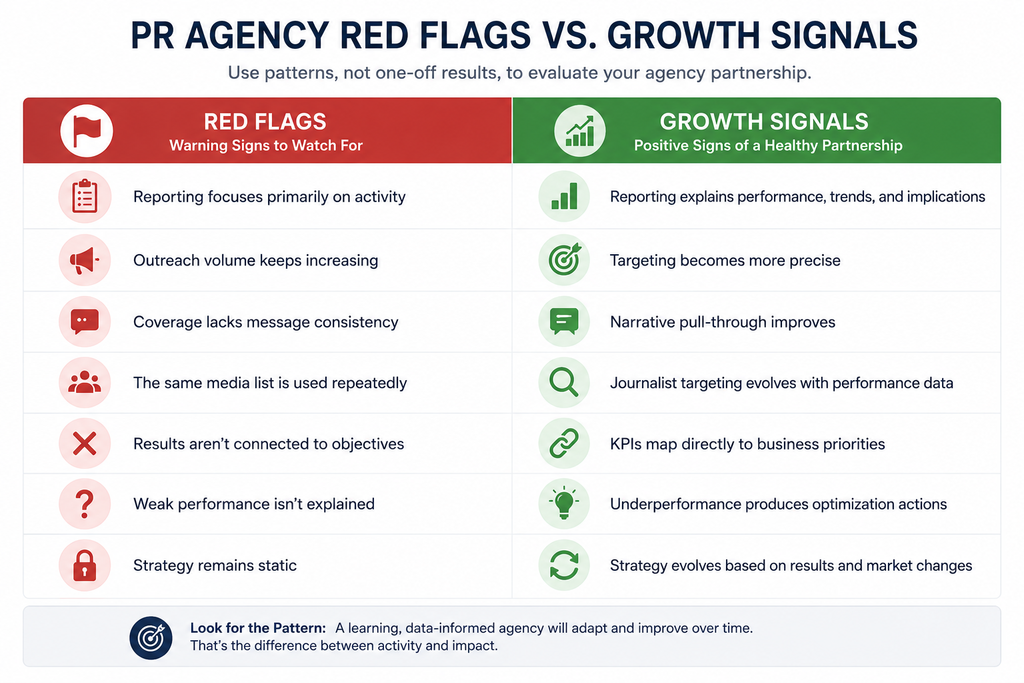
One weak response rate or missed placement may simply reflect bad timing, increased competition, or an unfavorable news cycle.
Persistent weaknesses without corresponding changes are more concerning.
Performance Gaps Aren’t Always Partnership Problems
A performance gap reveals that part of the PR system isn’t producing the desired result, but it doesn’t automatically tell you why.
Example: An agency might have strong media relationships and excellent execution, but it lacks the tech or analytics needed to measure narrative pull-through at scale. Another agency might produce strong coverage, but it needs better media intelligence to refine targeted outreach.
Those gaps are often addressed through:
- Better Data
- Stronger Measurement
- Improved Targeting
- Narrative Refinement
- Workflow Optimization
- Additional Specialist Capabilities
In these situations, optimization or augmentation may produce better results without disrupting an otherwise productive agency relationship.
When a Gap Becomes a Partnership Problem
Significant warning signs usually involve how the agency responds when gaps are identified.
Raise your level of concern when the agency consistently:
- Avoids Performance Questions
- Resists Measurement or Transparency
- Repeats Underperforming Tactics
- Cannot Explain Why Results Changed
- Dismisses Data That Challenges Existing Strategy
- Provides Few Actionable Recommendations
- Fails to Implement Agreed-Upon Improvements
Agencies don’t need every campaign to succeed. There are too many external variables in PR for that to be a realistic expectation.
But agencies should demonstrate a repeatable ability to learn from outcomes and turn those lessons into better decisions.
Look for Learning Velocity
Learning velocity is one of the strongest signals of a healthy PR partnership.
Example: Journalist response drops during a campaign. A stagnant program will likely respond by increasing pitch volume. But a learning-oriented agency will:
- Investigate the decline.
- Identify which narratives or journalist segments underperformed.
- Adjust targeting or messaging.
- Measure whether the change improves engagement.
That creates a continuous performance loop.
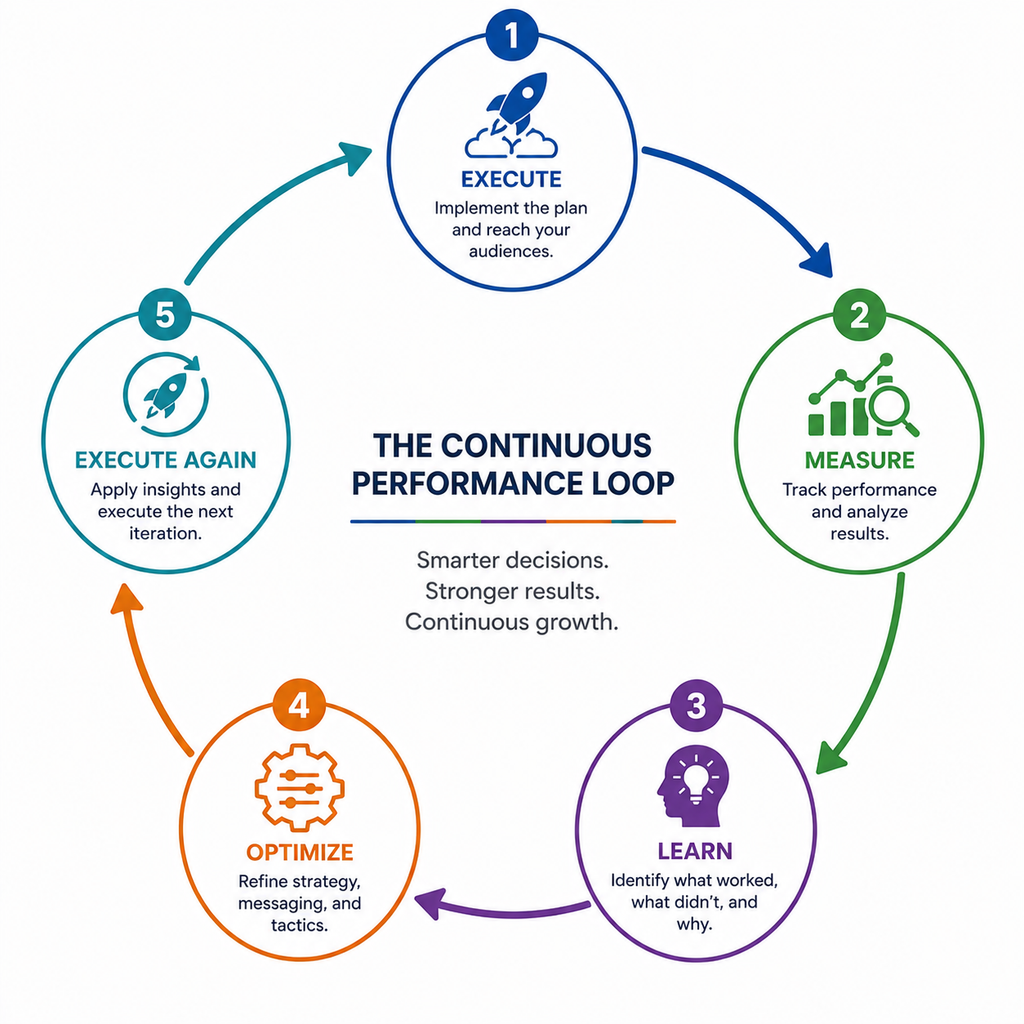
Over time, the agency should be able to immediately answer:
- Which journalists engage?
- Which narratives resonate?
- Which outlets create strategic value?
- Which tactics deserve greater investment?
That’s the difference between an agency that simply performs PR activity and a partner who helps you build a more mature PR program.
Pro Tip: Look for learning velocity. An agency doesn’t need every campaign to succeed, but it should become smarter because of every campaign it runs.
Need a useful framework for turning business objectives, audiences, messaging, and execution priorities into a more structured PR strategy? Read our guide: How to Write an Effective PR Plan [Tips + Examples]
How to Conduct a PR Agency Performance Audit
If performance feels uneven or lacking in any way, don’t immediately jump to, “Do we need a new agency?”
A better question to ask is, “Where’s the system actually breaking down?”
A structured PR agency performance audit turns a subjective review into a diagnostic process. Conduct one every 3–6 months or before a major contract decision to:
- Establish what is working.
- Isolate performance gaps.
- Create a measurable path forward.
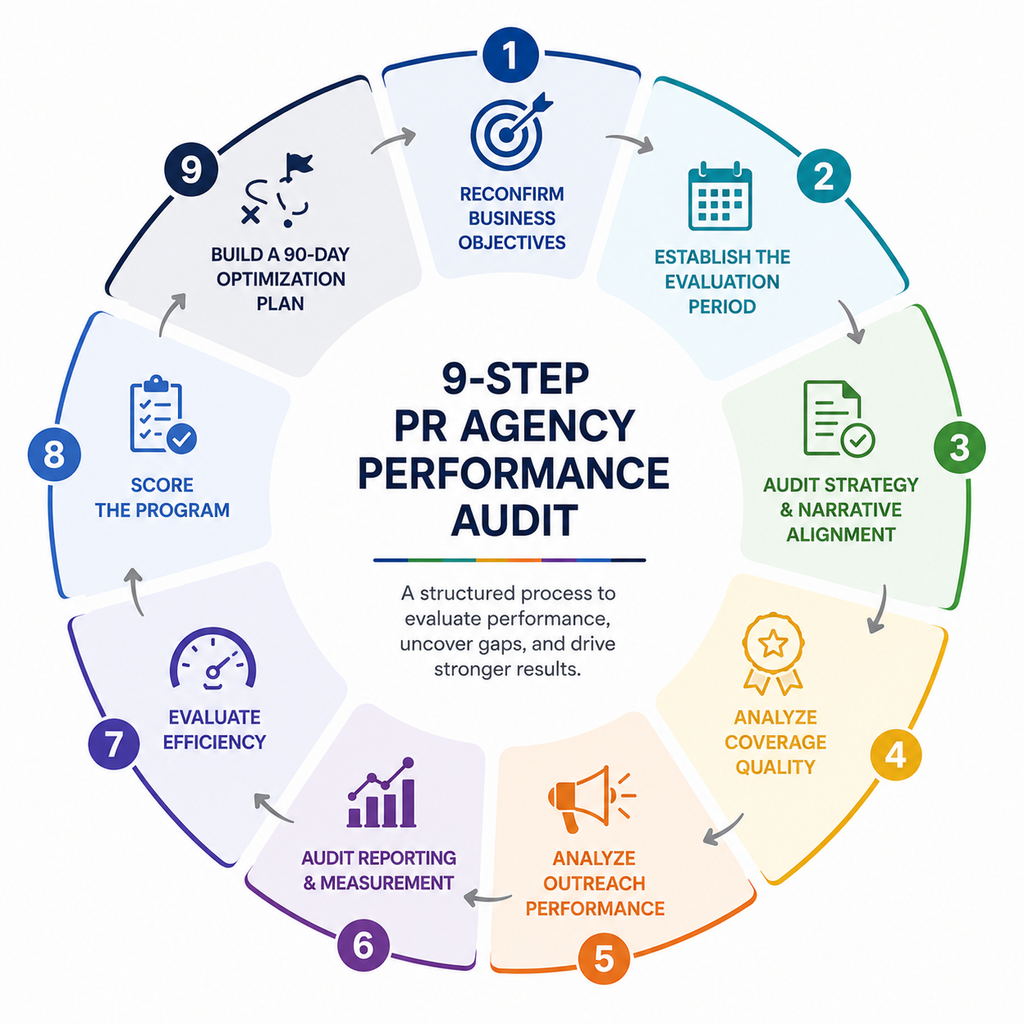
Step 1: Reconfirm Business Objectives
You need to define what the PR program is expected to accomplish before evaluating performance.
Revisit priorities such as:
- Category Leadership
- Executive Visibility
- Product Awareness
- Market Expansion
- Fundraising or Investor Confidence
- Sales Enablement
- Talent Acquisition
If you haven’t set clear objectives, even strong coverage becomes difficult to evaluate meaningfully.
Step 2: Establish the Evaluation Period
Reserve agency judgement until patterns emerge. One unusually strong or weak month shouldn’t inform evaluation.
Choose a period long enough to spot meaningful trends — typically 3–6 months. Account for factors that influence performance like:
- Major Launches
- Seasonal Changes
- News Cycles
Compare the period against a relevant historical baseline whenever possible.
Step 3: Audit Strategy and Narrative Alignment
During this step, you should establish whether PR strategy still reflects the company’s positioning and business priorities.
Review:
- Priority Narratives
- Target Audiences
- Competitive Differentiation
- Executive Positioning
- Campaign Themes
- Upcoming Business Milestones
Make sure narratives are actually gaining traction. A strategy sometimes appears compelling on paper but fails to resonate with journalists or show up in earned coverage.
Step 4: Analyze Coverage Quality
Examine the strategic value of placements rather than just counting them.
Ask:
- Did coverage appear in priority outlets?
- Did it reach relevant audiences?
- Were priority messages included?
- Were executives positioned as authorities?
- Did coverage strengthen competitive positioning?
- Are high-value publications engaging repeatedly?
This draws a clear distinction between sheer visibility and coverage that meaningfully advances the PR strategy.
Step 5: Analyze Outreach Performance
Next, work backwards from coverage to see if outreach is effectively and efficiently creating opportunities.
Compare journalist response, positive response, interview conversion, placement conversion, and repeat engagement across:
- Narratives
- Campaigns
- Journalist Segments
- Priority vs. Non-Priority Media
- Current vs. Previous Evaluation Periods
Try to find patterns. If a particular narrative consistently earns twice the response rate of another, that’s not just an interesting statistic — that’s actionable intelligence. determine whether targeting, relevance, timing, or the narrative itself explains the difference.
Document the strongest and weakest patterns so they can inform the 90-day optimization plan in Step 9.
Step 6: Audit Reporting and Measurement
Is reporting providing leadership with enough information to not only understand performance but improve it?
Remember, a mature report should always answer:
- What happened?
- Why did it happen?
- What did we learn?
- What changes next?
Look for trend analysis, transparent discussion of underperformance, business-aligned KPIs, and clear optimization recommendations. If a report documents activity that doesn’t help leadership make decisions, the reporting maturity is its own performance gap.
Step 7: Evaluate Efficiency
Performance is more than what the agency produces — it’s how effectively resources generate strategically valuable outcomes.
Depending on available data, evaluate:
- Cost per Strategic Placement
- Cost per Journalist Response
- Outreach-to-Coverage Conversion
- Time-to-Placement
- Performance by Campaign
- Resource Allocation by Narrative
- High- vs. Low-Performing Journalist Segments
Efficiency metrics often reveal areas of sensible investment increases — and where resources may be consistently underperforming.
Step 8: Score the Program
Return to the five-dimensional scorecard introduced in an earlier section:
| Dimension | What to Evaluate | Example KPIs | Score |
| Strategic Alignment | Connection to business priorities | Strategic objective alignment, narrative consistency | 1–5 |
| Coverage Quality | Relevance and authority | Target publication rate, message pull-through | 1–5 |
| Outreach Effectiveness | Journalist engagement | Response rate, interview conversion | 1–5 |
| Reporting and Transparency | Decision usefulness | KPI visibility, insights, optimization actions | 1–5 |
| Business Impact Alignment | Connection to growth | Visibility, authority, assisted conversions | 1–5 |
Score each dimension from 1–5 using consistent criteria and supporting evidence. But remember not to obsess over the total.
A PR agency evaluation scorecard is most useful for revealing performance imbalances.
Example: A program scoring highly on coverage but poorly on strategic alignment may be generating results that don’t sufficiently support business priorities.
Step 9: Create a 90-Day Optimization Plan
An audit isn’t valuable if it ends with a score.
Prioritize a small number of improvements and establish KPIs for measuring progress. Turn the most important findings into a focused improvement plan:
| Performance Gap | Corrective Action | Owner | KPI | Review Date |
| Low journalist response | Refine targeting and pitch segmentation | Agency | Response rate | 30 days |
| Weak message pull-through | Tighten priority narratives | Joint | Message pull-through | 60 days |
| Activity-heavy reporting | Add business-aligned insights | Agency | Reporting maturity | 30 days |
| Low priority-outlet coverage | Rebalance media targets | Joint | Priority coverage rate | 90 days |
Restrict the plan to gaps that are most likely to improve overall performance. Assign ownership, establish KPIs, and set a review date so that both the internal team and agency know what progress should look like.
You end up with a much stronger basis for evaluating PR agency accountability than just asking whether leadership is satisfied with the relationship.
Pro Tip: Treat an agency audit as a diagnostic exercise, not a verdict. The objective is to isolate constraints and determine what needs to improve next.
For frameworks that help connect PR investment with measurable and assisted business impact, check out our guide, Earned Media Measurement: The Executive Playbook for PR ROI in 2026 [Examples + Tips]
When to Optimize vs. When to Replace Your PR Agency
We’ve already established that disappointing performance doesn’t automatically mean the agency relationship is a failure.
Sometimes the relationship is just fine, but a specific capability, workflow, or measurement gap is stifling performance improvement. In other cases, persistent problems point to a deeper incompatibility that optimization alone won’t solve.
You need to distinguish between the two before making any costly partnership decisions.
Optimize When the Foundation Is Strong
Some areas of performance may need work. If an agency demonstrates its strategic value and a willingness to improve, optimization makes sense.
Consider optimizing when:
- Strategy is sound but execution is inconsistent.
- Coverage quality is improving.
- Journalist engagement shows positive momentum.
- Reporting gaps can be corrected.
- The agency responds constructively to performance data.
- Additional tools, intelligence, or specialist capabilities could close gaps.
Example: An agency consistently secures relevant coverage but lacks sophisticated analytics for measuring narrative pull-through or journalist engagement. That’s a capability gap — not necessarily a reason to end a productive partnership.
In similar cases, adjustments like better data, clearer benchmarks, improved workflows, or specialized augmentation may unlock more value from the existing investment.
Consider Replacement When Problems Are Structural
Replacing an agency becomes more reasonable when weaknesses are persistent despite clear:
- Expectations
- Adequate Resources
- Repeated Attempts to Improve
Consider replacement when:
- Strategic alignment remains persistently weak.
- Transparency is consistently lacking.
- The agency cannot explain performance.
- Reporting never progresses beyond activity metrics.
- Targeting remains unfocused despite repeated intervention.
- Optimization recommendations repeatedly go unimplemented.
- Business objectives and agency capabilities are fundamentally misaligned.
The distinction matters. One bad quarter is a performance issue. The consistent inability or unwillingness to adapt is a partnership issue.
But even in the latter case, replacement should follow evidence — not frustration.
Use a 90-Day Improvement Window
Before making a final decision — if you feel there’s still a workable foundation — assign definitive corrective opportunities to significant performance gaps.
Example: From Performance Gap to Decision
You’re a growth-stage B2B tech company. You discover that your agency’s journalist response rate has declined for two consecutive quarters. Coverage is still coming in, but fewer placements appear in priority publications, and outreach volume is increasing.
Instead of immediately replacing the agency, your company establishes a 90-day improvement window.
Working together with a defined framework, you’re able to:
- Refine journalist segmentation.
- Narrow the target media list.
- Test stronger narrative angles.
- Begin tracking response rates by pitch and journalist segment.
After 90 days, leadership evaluates three signals:
- Responsiveness: Did the agency implement the agreed-upon changes?
- Learning: Can it explain which adjustments worked, which didn’t, and why?
- Momentum: Are response rates, priority-outlet engagement, or other leading indicators improving?
If all three are moving in the right direction, optimization is working — even if coverage hasn’t transformed overnight.
If the same problems persist and the agency isn’t demonstrating meaningful adaptation, leadership has stronger evidence that the issue is more structural than performance-based.
Diagnose the Problem Before Changing the Partner
A major risk in replacing an agency too quickly is bringing the same underlying issues into the next agency relationship. Before making the change, identify underperformance at its source.
Does the fundamental problem lie with:
- The Agency
- The Strategy
- The Operating Model
- Internal Bottlenecks
- Measurement Infrastructure
- Technology or Data
- A Specialized Capability Gap
If leadership is rarely available, approvals regularly take weeks, or the company lacks differentiated narratives, a new agency will likely encounter the same constraints.
This is where the decision becomes less binary.
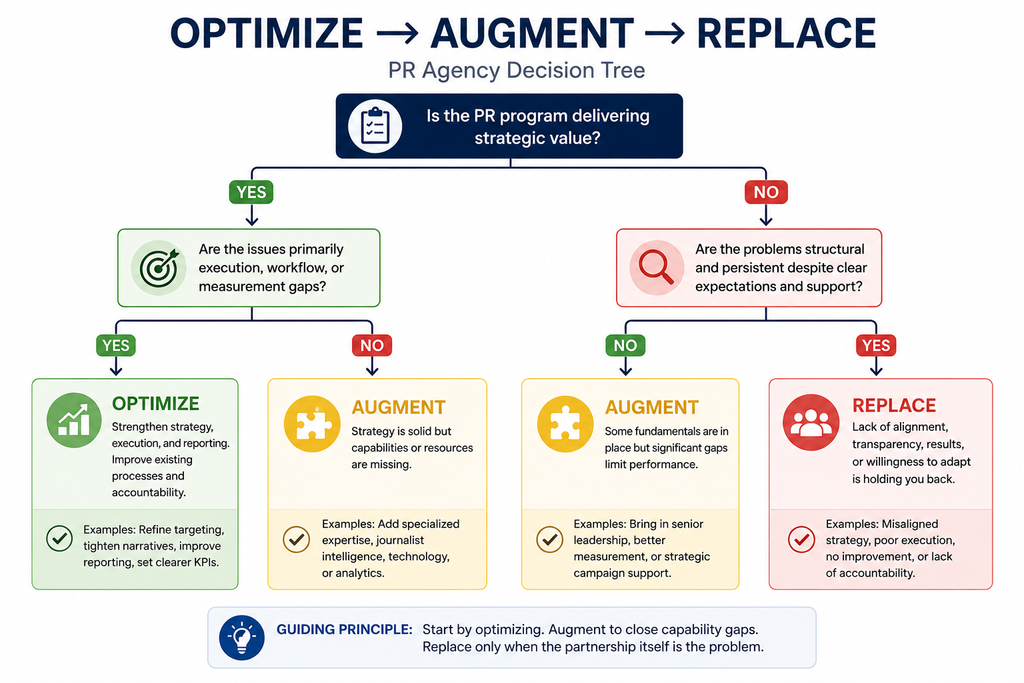
- Optimization improves the existing system.
- Augmentation adds missing intelligence, technology, measurement, or specialized capabilities.
- Replacement becomes appropriate when the underlying partnership itself is preventing progress.
This sequence gives leadership a structured way to protect existing PR investment while still holding partners accountable for performance.
Pro Tip: Before replacing an agency, determine whether the problem is the partner, the strategy, the operating model, or a capability gap. Changing agencies won’t fix structural issues that follow the program.
For more on how targeting, narrative development, measurement, and optimization work together in a more mature earned media program, read our guide: The Modern Earned Media Strategy Guide for Enterprise B2B Tech Brands [Examples + Tips]
How Augmentation Improves Agency ROI
What do you do when optimization isn’t enough, but replacement feels like an overreaction?
Consider agency augmentation.
This third option helps strengthen an existing relationship by adding the intelligence, technology, measurement, or specialized expertise the current operating model lacks.
For enterprise and growth-stage teams, this helps improve PR agency ROI while preserving the relationships, institutional knowledge, and capabilities that are already producing value.
Fill Capability Gaps Without Rebuilding the Program
The strongest agencies don’t excel at every function.
One agency might have great media relationships but limited analytics. Another might execute campaigns effectively but lack the technology to analyze journalist engagement or narrative performance at scale.
An augmentation layer adds capabilities such as:
- Media Intelligence
- Journalist Targeting
- Outreach Analytics
- Narrative Performance Analysis
- Reporting Infrastructure
- Campaign Optimization
- Performance Benchmarking
You’re not trying to duplicate an agency’s work. The goal is to fill the specific gaps that are impeding a higher level of performance.
Give Agencies Better Intelligence
Better inputs boost an existing agency’s capabilities.
Example:
- Media intelligence helps identify which journalists are actively covering relevant topics.
- Outreach data reveals which narratives generate responses.
- Coverage analysis shows whether priority messages are actually reaching the final story.
This creates a stronger operating model:
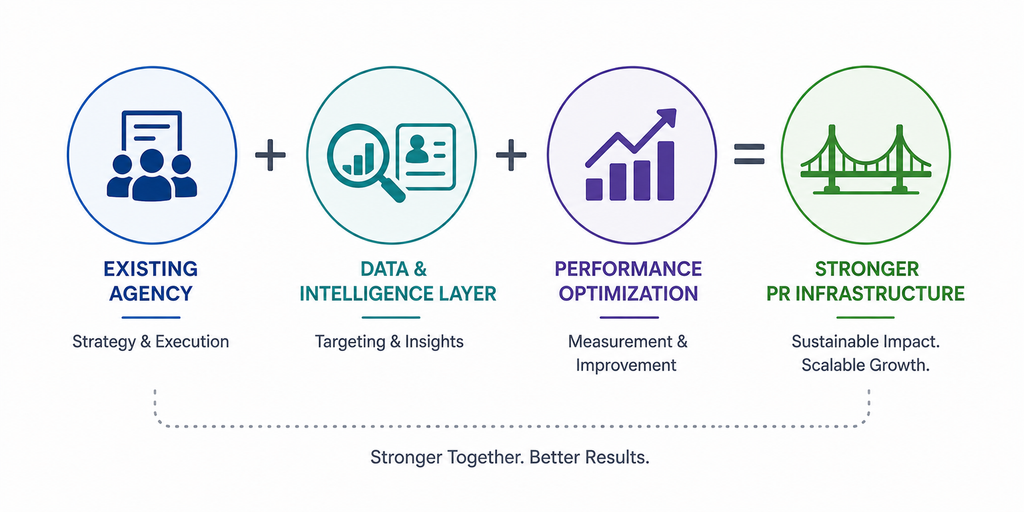
Instead of demanding more activity from an agency, augmentation helps them make better decisions about:
- Focus
- Targeting
- Optimization
Increase Accountability Without Creating Friction
Accountability works best when everyone uses the same evidence to evaluate performance.
Create a shared measurement framework to give internal PR teams, agency partners, and executive leadership greater visibility into:
- Strategic Priorities
- Performance Benchmarks
- Journalist Engagement
- Coverage Quality
- Narrative Pull-Through
- Optimization Priorities
- Business Alignment
This moves performance conversations from “I don’t think PR is working” to “Here’s where performance is improving, here’s where gaps remain, and here’s how we’re going to fix it.”
Accountability becomes shared performance management rather than a blame game.
Build an Enterprise-Ready PR Operating Model
PR becomes more complex as organizations grow. Consistent execution is increasingly difficult when there are multiple:
- Executives
- Product Lines
- Markets
- Agencies
- Internal Stakeholders
Augmentation provides a connective layer between those moving parts:
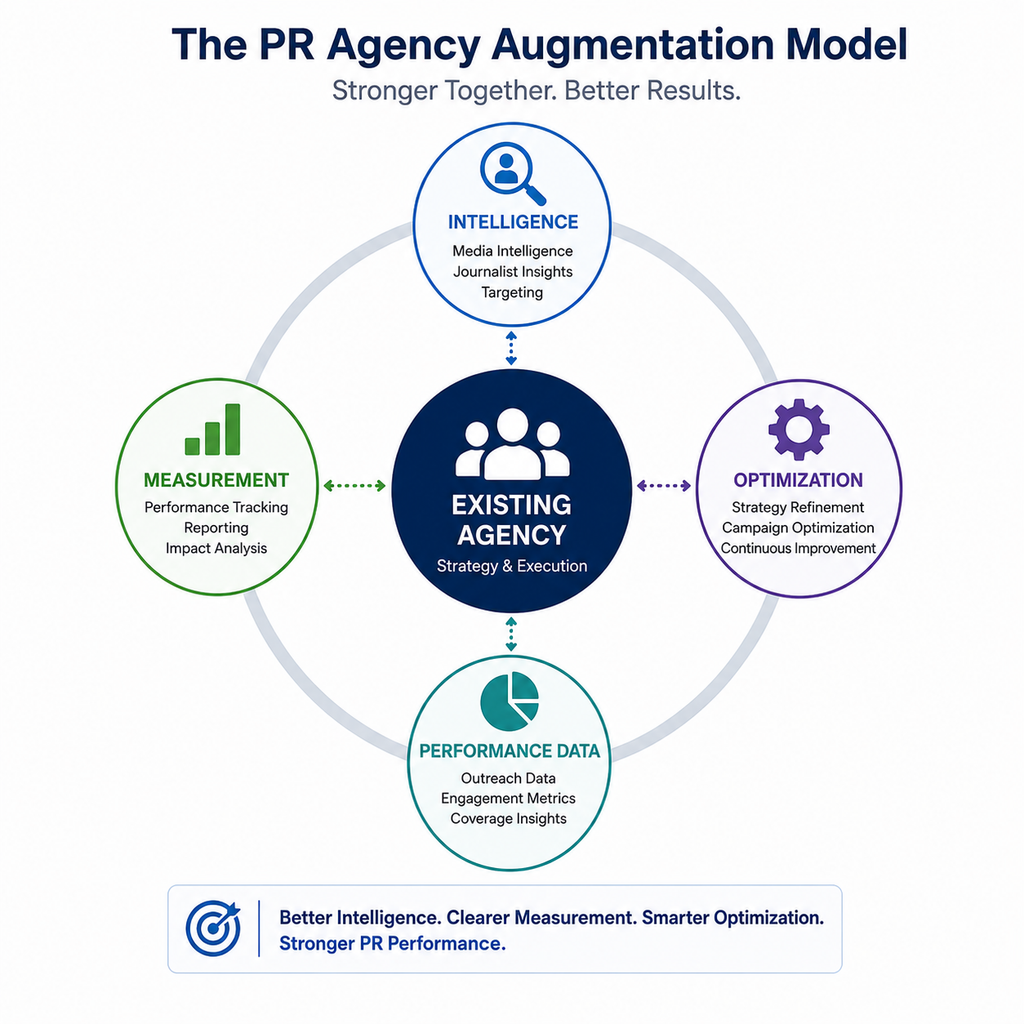
You end up with a more mature operating model — one where performance data always informs the next campaign instead of vanishing into a monthly report.
- For enterprise teams, that means greater scalability, transparency, and consistency.
- For agencies, it means better intelligence and clearer performance signals.
- For leadership, it creates a stronger foundation for evaluating B2B PR agency performance and investment decisions.
Pro Tip: Augmentation works best when it strengthens what an agency already does well while supplying the intelligence, measurement, or infrastructure the existing operating model lacks.
Further explore how media intelligence, measurement, targeting, and optimization work together to build scalable earned media performance here: Earned Media in the Digital-First World: The Ultimate Guide to No-Cost Coverage [Examples + Tips]
Better PR Decisions Start With Better Evaluation
Whether PR is working should never be answered with gut instinct, vanity metrics, or a single anomalous month.
Objective evaluation takes into account the complete performance system:
- Strategic Alignment
- Coverage Quality
- Outreach Effectiveness
- Reporting Transparency
- Business Impact
Together, these dimensions show whether results are improving, where gaps originate, and what should happen next.
And the next step doesn’t always mean finding a new agency. Sometimes the more sensible path forward is to optimize what’s working, augment missing capabilities, and equip your existing partner with better intelligence to make better decisions.
A PR Performance Audit or Agency Optimization Review helps your team:
- Identify performance gaps.
- Uncover Opportunities.
- Determine where stronger intelligence, measurement, or augmentation could improve your PR investment.
Ready to replace guesswork with evidence? Book a free consultation with us today and start building a more accountable and measurable PR program.