What Does Earned Media AI Visibility Actually Mean for PR?
By Tim Gray “How do you measure PR?” Every PR professional has been asked that question, often by someone who wants a clean number. We can count coverage, examine the audience, track referral traffic and look for changes in search. Each measure t...
- Home
- Intelligent Insights Blog
- What Does Earned Media AI Visibility Actually Mean for PR?

By Tim Gray
“How do you measure PR?”
Every PR professional has been asked that question, often by someone who wants a clean number. We can count coverage, examine the audience, track referral traffic and look for changes in search. Each measure tells us something. None captures everything a good story can do.
Now there’s another question to ask: When someone turns to an AI tool to learn about your market, does your company show up? If it does, does the answer get your company right? Understanding your earned media AI visibility is becoming a vital part of modern reputation management.
This is where earned media comes in. Earned media can be a powerful signal for AI answer engines because it gives them independent reporting about a company, beyond what the company says about itself.
Research offers a reason to look closer. A study comparing AI search engines with Google found that the AI tools tested drew heavily on third-party sources. Ahrefs found that web mentions correlated more strongly with appearances in Google’s AI Overviews than backlinks did. Web mentions include more than earned media, and neither study shows that a news story will change an AI answer. Both point to the value of examining what others publish about a company.
The Gap a Coverage Report Won’t Show
A company can land good stories and still be absent when someone asks an AI tool about its category. Or it may show up with an outdated description that misses what the company does today.
Take a company once known for its hiring software. Today it also helps businesses understand the skills their employees have and the work they’ll need to do next. If an AI tool still describes it only as a hiring company, the PR team has something concrete to investigate: do recent stories explain what the company does now?
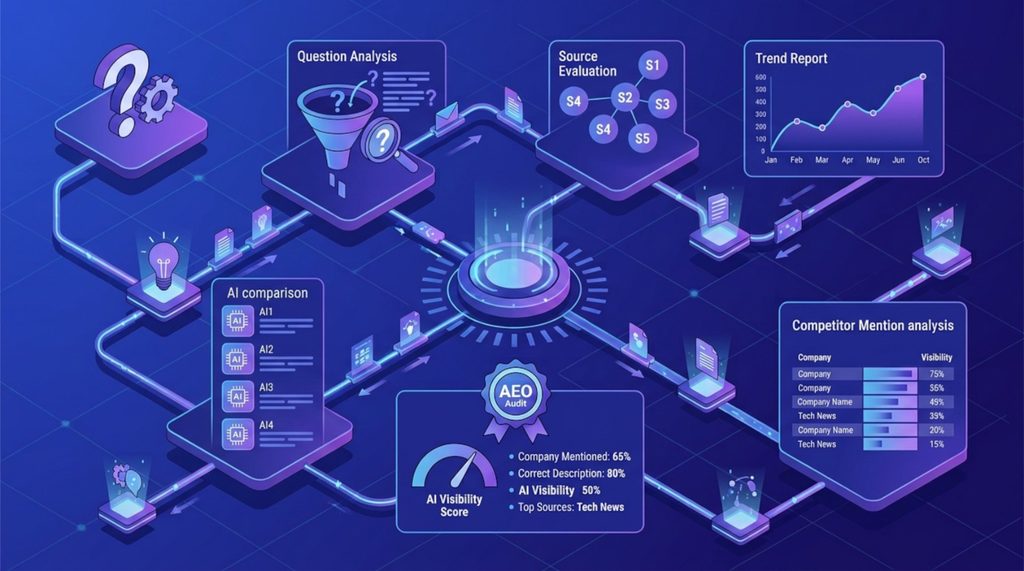
A coverage report tells you where a story ran. It won’t tell you what happens when a potential buyer asks ChatGPT which companies solve a problem in your market. Checking those answers, including whether your company appears, how it’s described and which sources the tool cites, is a practical starting point for answer engine optimization, or AEO.
How to Run a Simple Baseline Test for AEO
You can start with a spreadsheet and a set of questions.
1. Write the questions
Choose 15 to 25 questions a buyer or journalist might ask. Mix broad questions (“Which companies help employers understand their workforce?”), practical ones (“How can a company identify skills gaps?”), comparisons between providers, and direct questions about your company. Keep the wording so you can use the same questions next time.
2. Run them separately
Ask each question in a fresh chat across tools such as ChatGPT, Gemini, Claude and Perplexity. Note the date and whether web search was on. You can also try the questions in Google Search and note when an AI Overview appears. Don’t ask follow-ups in the same chat; earlier answers can affect later ones.
3. Save the answers
Keep the full response and its source links. Note whether your company appears, how it’s described, which competitors are named and whether the tool recommends anyone. Open the cited links, too. A source may be listed without supporting what the answer says.
4. Repeat the test
Run the same questions monthly or quarterly, using the same settings when you can. Answers vary, so look for patterns across questions and tools. One mention or one omission doesn’t tell you much on its own.
Turning AEO Findings into Better PR Strategies
If competitors keep appearing and your company does not, read the sources the tools cite. Do those stories cover work your company also does? If so, ask whether a journalist looking into that issue would find a clear, current explanation of your company’s role.
If the company is described incorrectly, check its website, press materials and directory listings for outdated language. Look at older coverage, too. Fix what you control, then consider whether there’s a timely story that would help journalists understand the company’s work today. A pitch still needs news or a useful point of view.
Conclusion: Driving Earned Media AI Visibility
PR has always helped shape what people know about a company. AI answers give us another place to see how well that work is carrying through. The test won’t tell you whether a particular story changed an answer, but analyzing your earned media AI visibility can show where your company appears, where it’s missing and where the description falls short. Use what you find to guide the next story worth telling.
Want to see how your company shows up in AI answers? Intelligent Relations can help you establish a baseline and identify the PR opportunities the results reveal. Get in touch.
Ready to transform your PR strategy?
Get access to Intelligent Relations before your competitors do.